
AI Tools for Influencer Discovery and Campaign Management
October 26, 2026 · 11 min read
Influencer marketing software now ships with copilots and full AI agents that promise to find, vet, pitch, and report on creators. Marketers are already putting them to work: in Influencer Marketing Hub's 2026 benchmark, 36.67% of marketers said they use AI for creator discovery, the most common AI use case in influencer workflows, while only 10.56% reported no AI use at all.
Here's the catch: "AI-powered" can mean anything from a smarter search filter to an agent that sends emails on your behalf. Some of the work happens without a person. Much of it still waits for one, and vendor pages tend to not disclose which is which.
This review sorts seven tools by the campaign stage they automate, scores how much of that work their AI can run, and flags where a human still has to decide. The six stages covered are:
- Creator discovery
- Fake follower and audience checks
- Outreach
- Briefs and approvals
- Campaign tracking
- Reporting
If you need a shortlist fast, start with the comparison table. If you're about to sign a contract, read the full reviews, because the limitations are as important as the feature lists.
Quick Comparison of 7 AI Influencer Marketing Tools by Workflow Stage
The table summarizes what each tool is best for, its main strength and limitation, and its autonomy score out of 100. The scoring method is explained in the next section.
Disclaimer: Scores describe just the software. Whoever operates it, whether your own team or an influencer marketing agency, still has to review what the AI produces before it reaches creators.
| Tool | Best for | Primary strength | Main limitation | Autonomy score |
|---|---|---|---|---|
| Modash | Creator search and fake follower rates | Large searchable database with a documented fake follower method | AI classifies and ranks; people do every action | 42 |
| HypeAuditor | Audience quality scoring | Machine-learning Audience Quality Score on six platforms | Score weighting is proprietary; pricing behind a demo | 46 |
| EchoTik | TikTok Shop creator research | Sales and GMV signals next to creator data | TikTok only; outreach stays manual | 36 |
| Upfluence | AI-drafted briefs and agent outreach | Jaice copilot plus an MCP server that can send outreach | Key AI features in beta or on request | 76 |
| GRIN | Agent-run creator programs | Gia plans and runs work from discovery to reporting | Wallet management fees of 5% to 20% | 96 |
| Insense | Campaign operations through MCP | Inbox and approvals handled from Claude or ChatGPT | Actions need confirmation unless authorized in advance | 80 |
| CreatorIQ | Enterprise measurement and brand safety | Content-level search and always-on risk flags | Enterprise sales process; no published pricing | 52 |
How Each Tool's AI Autonomy Was Rated
Each tool received an autonomy score out of 100, built from three weighted factors.
- AI action depth (50% of the score). This is the factor that matters most, because it measures what the AI actually produces. A 1 means search and filters only. A 2 means the AI scores or classifies, for example a fake follower rate. A 3 means it drafts work such as briefs, shortlists, or emails. A 4 means it takes actions after you approve them. A 5 means it plans and runs multi-step work and returns only the exceptions.
- Stage coverage (30%). This counts how many of the six campaign stages the AI helps with, beyond the software around it. A 1 covers one stage, a 2 covers two, a 3 covers three, a 4 covers four or five, and a 5 covers all six. Broad coverage matters because every handoff between tools is a place where data gets retyped and mistakes creep in.
- Approval design (20%). This rates how safely you can let the AI work. A 1 means the AI takes no actions, so there is nothing to approve. A 2 means the AI can act, but the vendor documents no review step. A 3 means each action waits for a person, either through a fixed approval step or because it only runs when you ask. A 4 means the agent shows its plan first and lets you choose which steps need approval. A 5 would add documented logs or rollback, which none of the seven describes on the pages we checked.
Each factor is scored from 1 to 5, multiplied by its weight, and added up.
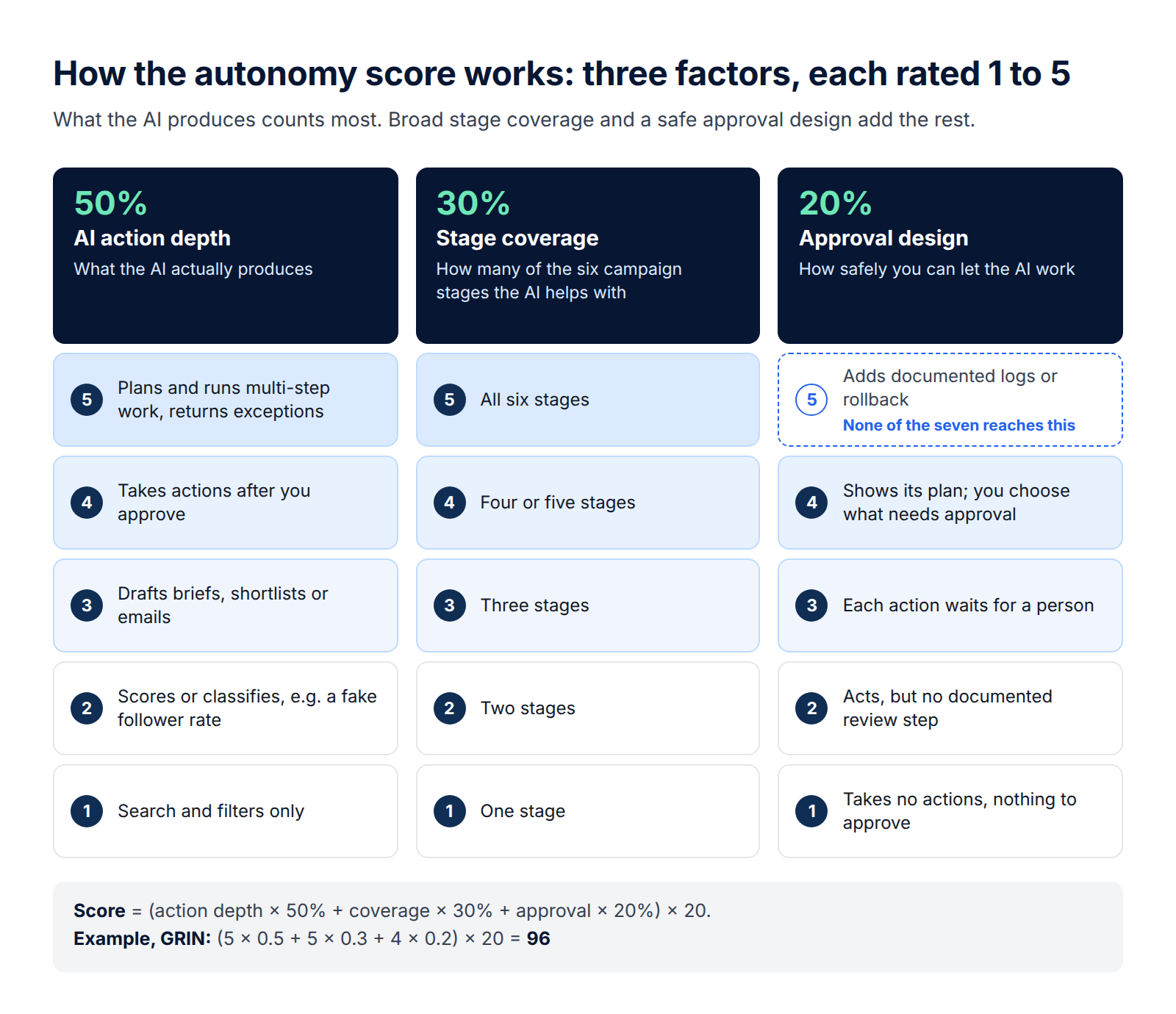
Each tool is rated 1 to 5 on three weighted factors; what the AI actually produces counts for half the score.
7 AI Tools for Influencer Discovery and Campaign Management
The seven tools run in campaign order, from finding creators to reporting on them. For more options, AI Agent Store keeps a directory of influencer discovery agents.
1. Modash: Best for Creator Search and Fake Follower Rates
Modash is a creator search and campaign platform aimed at in-house brand teams. It lets you search 380M+ profiles by audience location, age, and gender, find lookalikes of creators who already perform for you, and track posts, link clicks, and promo-code redemptions without asking creators to sign up.
Its fake follower method is the most clearly documented of the group. Modash samples a creator's followers, sorts each account into one of five types, and counts suspicious and bot accounts as fake. It also publishes benchmarks by account size, so you can see whether a rate is normal.
Score breakdown: action depth 2/5, stage coverage 3/5, approval design 1/5.
What the AI does: classifies follower samples, benchmarks fake rates by creator size, and suggests lookalike creators.
Where a person still decides: fit, outreach, and terms. Modash itself warns that a high fake rate isn't an automatic no.
Pricing: from $199 a month, billed yearly, and a 14-day trial.
2. HypeAuditor: Best for Audience Quality Scoring
HypeAuditor is a discovery and analytics platform built around audience authenticity. Its database covers 227.8M+ profiles across six platforms, including Instagram, YouTube, TikTok, X, and Twitch, with 35+ search filters, lookalike search, brand-mention tracking, and a Chrome extension that shows scores while you browse.
The headline feature is the Audience Quality Score, a 1-100 rating that combines engagement patterns, follower growth anomalies, profile metadata, and comment authenticity.
Two cautions apply. The weighting behind the score is proprietary, so you can't see why a creator scored 62 instead of 75. Plus HypeAuditor's own documentation describes detection as probabilistic and recommends human review before signing, which is an unusually honest admission.
Score breakdown: action depth 3/5, stage coverage 2/5, approval design 1/5.
What the AI does: scores audiences with machine learning, and its AI Scout reads a written brief and returns a matched creator shortlist.
Where a person still decides: whether a flagged creator is actually a risk, and everything after the shortlist.
Pricing: available only after a demo.
3. EchoTik: Best for TikTok Shop Creator Research
EchoTik is a TikTok Shop analytics platform, and its creator search works differently from the general tools above. It starts from sales data: you can find the products and shops selling in your category, see which creators drove that revenue, then filter creators by GMV and conversion signals before you look at follower counts.
For a brand selling on TikTok Shop, that changes the shortlist. A creator with 40,000 followers who has already sold products like yours is, in many cases, a better bet than one with 400,000 who hasn't.
EchoTik also monitors live streams and competitor shops, overlays revenue estimates on the TikTok feed through a Chrome extension, and offers an API.
Score breakdown: action depth 2/5, stage coverage 2/5, approval design 1/5.
What the AI does: collects and structures TikTok commerce data, including speech recognition on videos and trend analysis.
Where a person still decides: almost everything else, including outreach, which happens through invites, email, or TikTok's own marketplace.
Pricing: A free plan exists, and paid plans start at $10.19 a month.
4. Upfluence: Best for AI-Drafted Briefs and Agent Outreach
Upfluence is an influencer and affiliate marketing platform built for e-commerce and DTC brands. Its Jaice copilot drafts creator briefs, suggests compensation models, and searches the Upfluence marketplace.
The more agent-like feature is the Upfluence MCP server. Connected to Claude, ChatGPT, or another Model Context Protocol (MCP) client, it searches 14M+ creator profiles in plain language, checks audience authenticity, shortlists and approves creators, and drafts outreach that you review before it sends.
Both features carry caveats: Jaice launched in beta, MCP access is granted on request, and claims such as campaigns built "3x faster" are Upfluence's own.
Score breakdown: action depth 4/5, stage coverage 4/5, approval design 3/5.
What the AI does: drafts briefs and compensation, finds creators, and sends approved outreach.
Where a person still decides: the send button, plus negotiation and content review.
Pricing: custom.
5. GRIN: Best for an Agent That Plans and Runs Program Work
GRIN is a creator management platform, and Gia is the AI agent inside it. You describe an outcome, and Gia prepares the work across discovery, outreach, product gifting, briefs, deliverable tracking, and reporting.
Before acting, it shows a plan and lets you decide which steps need your approval. You can reach it on the web, in Slack, or through MCP.
That design earns the highest score here, but read it as documented capability, since we found no independent test of how well Gia performs.
Check the fee structure too. On top of the subscription, GRIN charges a management fee on wallet deposits, from 20% on the free plan to 5% on Scale. On the Starter plan's 10%, putting $10,000 in creator payments through the wallet costs an extra $1,000.
Score breakdown: action depth 5/5, stage coverage 5/5, approval design 4/5.
What the AI does: sources creators against personas you train, drafts outreach, coordinates gifting and briefs, and brings exceptions back to you.
Where a person still decides: whatever you mark for review, which should include anything involving money.
Pricing: plans start free, and Starter costs $200 a month after a 30-day trial.
6. Insense: Best for Running Campaigns From Your Own AI Assistant
Insense is a creator marketplace and campaign platform known for user-generated content (UGC) and ad-ready creator videos. It added natural-language creator search, so you can describe the creator you want in plain words, and an MCP connection to Claude or ChatGPT.
Through the Insense MCP connection, your assistant can pull campaign data, read and reply to creator messages, and approve deliverables or request revisions. You can give it written rules for approving content, a Slack integration posts campaign updates as they happen, and unresponsive creators get automated Instagram DM nudges through Meta's Creator Marketplace API. Actions such as messaging creators or approving content wait for your confirmation unless you've authorized the assistant to act without asking again.
Insense is upfront about the limits: its AI speeds up creator search, while deciding which creator fits your brand stays with your team.
Score breakdown: action depth 4/5, stage coverage 4/5, approval design 4/5.
What the AI does: matches creators to plain-language descriptions, handles creator messages and content reviews, and applies the approval rules you set.
Where a person still decides: which actions to authorize in advance and which still need individual review.
Pricing: Self-service plans start at $400 a month, billed yearly, plus marketplace fees on creator payments.
7. CreatorIQ: Best for Enterprise Measurement and Brand Safety
CreatorIQ is enterprise infrastructure for large, multi-brand creator programs. Its search indexes what 20M creators actually post, using up to 12 months of content refreshed daily. It adds always-on brand-risk flags, an analytics agent that answers questions from your own campaign data, and MCP access.
Note that 20M isn't directly comparable with Modash's or HypeAuditor's larger counts. CreatorIQ indexes content in depth, while the others count profiles, so database sizes measure different things.
CreatorIQ positions its AI as support for human judgment, which matches what its features actually do.
Score breakdown: action depth 3/5, stage coverage 3/5, approval design 1/5.
What the AI does: content-level search, ongoing brand-safety screening, and plain-language reporting.
Where a person still decides: partner selection, risk calls, and budget moves.
Pricing: requires a sales conversation.
How Much of Influencer Campaign Management AI Can Run on Its Own
AI can now handle most of the admin in influencer campaign management, from drafting outreach to compiling reports. Money, usage rights, and final approvals still sit with people in every tool reviewed here.
That workload grows as programs become ongoing: Later found that 70% of leading brands now prioritize ongoing creator partnerships over one-time activations.
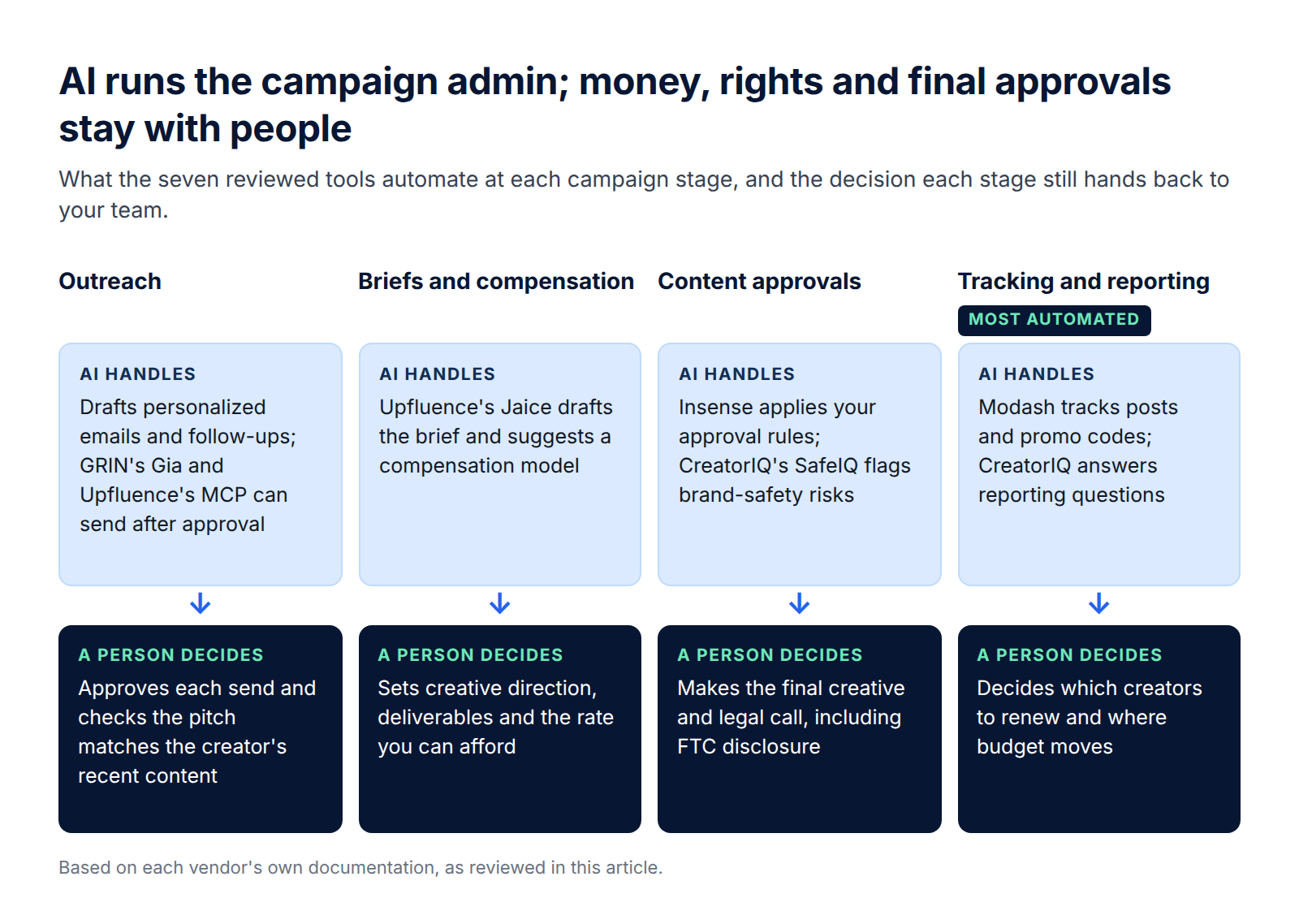
At every stage, the tools draft or flag the work, and a person still makes the call.
Outreach and follow-ups
Automated influencer outreach tools draft personalized emails and schedule follow-ups. GRIN's Gia and Upfluence's MCP server go a step further and can send them, but both put an approval step first.
Personalization still needs checking, because an AI that misreads a creator's recent content will write a pitch that shows it.
Briefs and compensation
Upfluence's Jaice drafts briefs and suggests a compensation model from your goals. Use the draft as a starting point. The creative direction, the deliverables, and the rate you can afford are still business decisions.
Any in-house team can now generate a brief with AI, so the advantage shifts to knowing what to cut. Specialist teams like inBeat Agency bring that judgment from campaigns across many brands. That’s why they keep each brief to one outcome, the product facts, and three to five non-negotiables.
Content approvals and disclosure
Insense lets you approve content from an AI assistant, and CreatorIQ's SafeIQ analyzes video, audio, and text for risks against your brand's safety and suitability standards. Your team should still make the final call on creative approval and legal compliance.
In the US, the FTC expects creators to disclose brand relationships clearly, and checking that disclosure belongs in the same review.
Tracking and reporting
Reporting is where automation is most mature. Modash tracks posts and promo codes automatically, and CreatorIQ answers reporting questions in plain language. The remaining human job is interpretation: deciding which creators to renew and where to move budget.
When an AI Influencer Marketing Agency Beats More Software
Another tool helps when your bottleneck is data or admin. When the bottleneck is judgment or headcount, more software rarely fixes it, and a specialist team usually does.
Volume and platform thresholds
Finding the right fit is still the hardest part. In an EMARKETER survey, 43.9% of US marketers named it their top creator marketing challenge, and 37.4% called long-term ambassador partnerships the most valuable new tactic.
Discovery tools widen the pool of candidates, and narrowing it still takes someone who knows the brand. Running several platforms at once multiplies that work.
Judgment calls tools cannot make
Negotiating usage rights, briefing creative that works as a paid ad, and deciding which creators to renew are calls none of these products automates.
Bringing in a specialist team makes sense when you need those decisions made every week and can't staff a team to make them.
What to ask an agency about its AI stack
Ask which tools the agency uses at each stage, who reviews AI-drafted outreach and briefs before they go out, and how it checks audience quality beyond a vendor score. A good answer names the tools and the people.
Which AI Influencer Marketing Tool Should You Choose?
Which AI tool fits your influencer program depends on where your campaigns slow down today and how much of that stage you're willing to hand to software:
- Modash suits teams that want transparent pricing and a clear fake follower method.
- HypeAuditor offers a detailed, documented audience quality score for vetting-heavy programs.
- EchoTik is the specialist pick for TikTok Shop sellers who recruit creators by sales.
- Upfluence fits e-commerce brands ready to test agent-led outreach from an AI assistant.
- GRIN documents the most autonomous agent, at the cost of wallet fees.
- Insense suits teams buying ad-ready creator content who prefer working inside Claude or ChatGPT.
- CreatorIQ serves enterprises that need governance and measurement across brands.
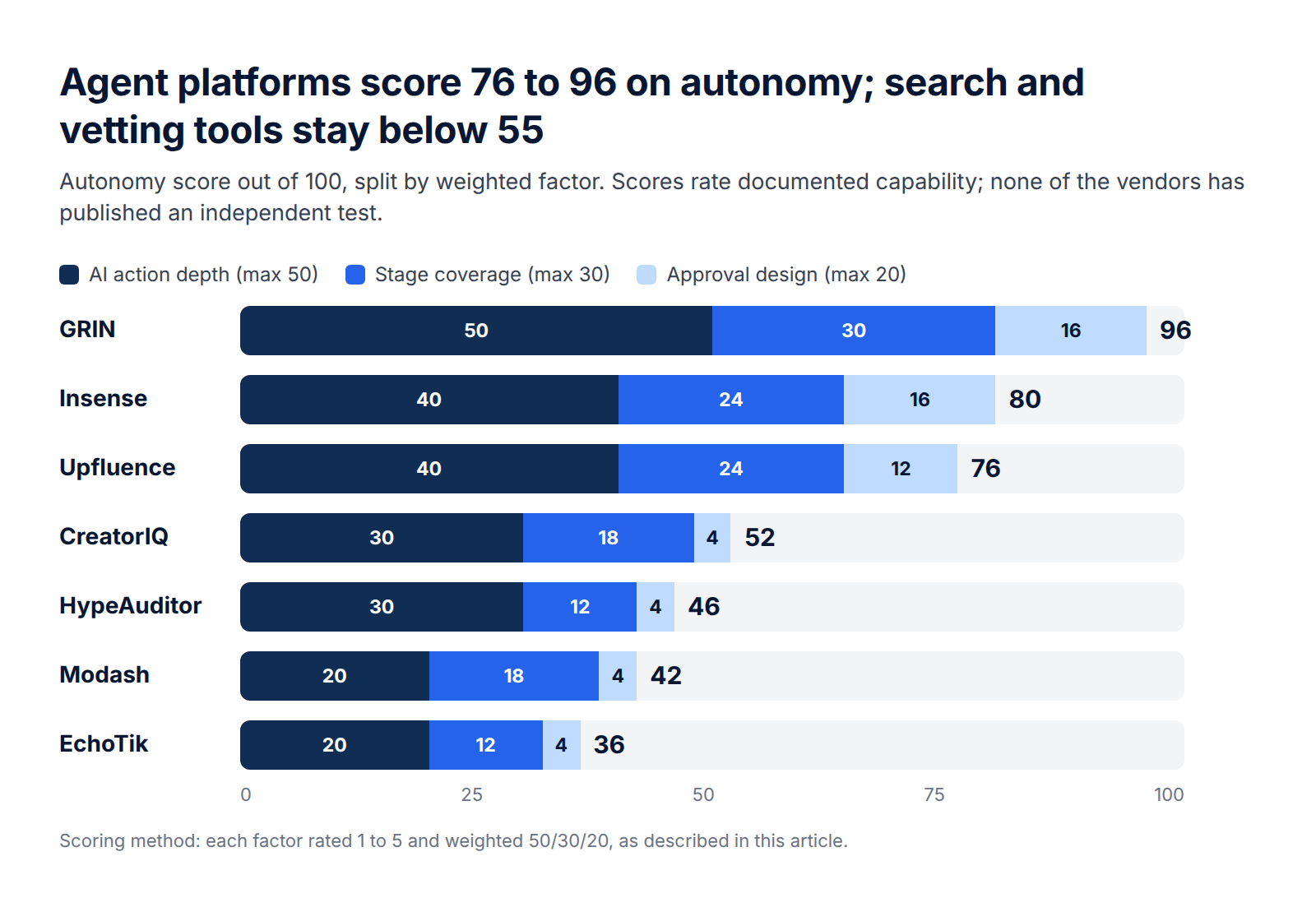
Autonomy scores split by factor: action depth drives most of the gap between agent platforms and search tools.
Whichever you choose, run a short pilot before you commit. Time how long your team spends per approved creator before and after the tool, and keep a person on every decision that involves money, rights, or brand risk. If that time drops and quality holds, the AI is earning its fee.
Frequently Asked Questions
Can AI reliably detect fake followers?
It reliably flags likely problems, but it can't prove them. Tools such as Modash and HypeAuditor estimate fake follower rates from samples of public data, and HypeAuditor calls its own detection probabilistic. Use the score as a first filter, then review flagged creators yourself.
Which AI influencer marketing tool is the most autonomous?
GRIN's Gia scored highest (96/100) because it plans and runs work across all six stages, with approvals you configure. Insense followed at 80 and Upfluence at 76. These scores rate documented capability, and none of these vendors has published an independent test.
Do these tools work inside Claude or ChatGPT?
Several do, through the Model Context Protocol. Upfluence (on request, in beta), GRIN, Insense, HypeAuditor, and CreatorIQ all document MCP access, which lets an AI assistant query creator data or act in your account.
How much do AI influencer marketing tools cost?
Published entry prices range from a free plan at EchoTik to $400 a month at Insense. HypeAuditor, Upfluence, and CreatorIQ quote on request. Check transaction fees as well as subscriptions, since some platforms charge a percentage of creator payments.
Do I still need an agency if I use AI tools?
It depends on volume and judgment. At low volumes, a tool plus one experienced marketer can usually cover vetting and outreach. Above that, or when you need paid-ad creative and rights negotiation every week, a specialist team usually adds more than another subscription.