
Turning Voice Agent Call Data into Predictive Models
October 14, 2026 · 6 min read
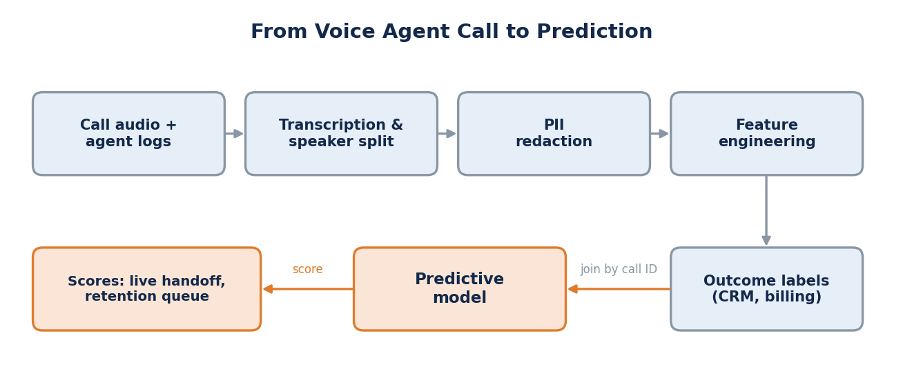
The usual path from a raw voice agent call to a score someone can act on.
Every call a voice agent takes ends up as a row somewhere. A transcript, a duration, a note that the caller asked for a human after the agent misread a billing question twice. Most teams glance at those rows in a weekly dashboard and move on. That habit leaves a lot on the table, because the same call logs that feed a containment-rate chart can also point to which customers are about to cancel, which callers will phone back tomorrow, and which parts of the agent's script quietly push people toward a human.
The volume alone makes the effort worthwhile. Back in 2022, Gartner projected that one in ten contact center interactions would be automated by 2026, up from about 1.6% at the time. Each automated call produces more structured data than a human-handled one: the voice agent logs its own intent guesses, confidence scores, fallbacks, and tool calls without anyone asking it to.
Getting from that raw exhaust to a working predictive model mostly comes down to plumbing, labeling, and figuring out which signals are real. The algorithm is the easy part. Companies often bring in Tensorway's ML experts at exactly this stage, since the hardest problems tend to sit between the telephony stack and the CRM, not inside the model. Here's how the process usually goes, and where it tends to break.
What's Actually Inside Voice Agent Call Data
Speech analytics used to mean running keyword searches over recorded calls. Voice agents give you far more to work with, and the data falls into four rough groups.
The transcript is the obvious one: what the caller said and what the agent answered, turn by turn. Then there's the audio, which carries information that text loses. Long silences before an answer. Callers talking over the agent. Pitch climbing in the last minute of a call. None of these cues appear in a transcript, yet they often reveal more about frustration than the words themselves.
That said, metadata matters as well: time of day, call length, number of transfers, whether the same number called last week. The last group is where voice agents beat human-staffed lines by a mile. You get the agent's own decision log, including every intent it detected, how confident it was, each time it fell back to "Sorry, I didn't catch that," and every API call it made to check an order or book a slot. A human agent never wrote any of that down.
On their own, these streams only describe what already happened. To predict anything, a model needs one more ingredient, which is the outcome. Did the customer churn within 60 days? Pay the overdue invoice? Call back about the same problem? Those answers live in the CRM, the billing system, or the ticketing tool, and joining them back to individual calls is usually the first real engineering task.
From Recordings to Model Features
Raw calls can't go straight into a model, so some groundwork comes before any modeling.
Transcription and speaker separation come first. Even if your voice agent platform stores its own transcripts, check them, because speech recognition errors cluster in predictable places: accents, background noise, product names, account numbers. A churn model that learns from the word "cancel" will miss the caller whose "cancel" came through as "can sell."
Next, redact personal data. Card numbers, addresses, and dates of birth have no business in a training set, and many jurisdictions require caller consent before a call can be recorded at all. When redaction happens before anything reaches the data warehouse, you avoid a painful cleanup later.
Feature engineering is where most of the predictive value gets made or lost. A single average sentiment score per call is close to useless. What matters is the trajectory: a call that starts neutral and ends angry looks nothing like one that starts angry and ends calm, yet both can average out to the same number. Good features tend to be specific, like the fallback count in the first two minutes, the share of silence, whether the caller asked for a person, or days since the last contact.
| Signal in the call data | What it can help predict |
|---|---|
| Repeated fallbacks ("Sorry, I didn't catch that") | Escalation to a human, low CSAT |
| Caller asks for a person early in the call | Complaint, churn risk |
| Same number calls again within 7 days | Failed first-contact resolution |
| Long pauses, talk-over, rising pitch | Frustration, likely cancellation |
| Competitor or price mentioned | Churn, need for a retention offer |
| Caller confirms a payment date and amount | Probability the payment actually arrives |
Common call signals and the outcomes they tend to correlate with.
Labeling closes the loop. Each call gets matched to its outcome over a fixed window, say 30 or 90 days. Watch for leakage at this step. If the model is allowed to see the cancellation call itself, it will score beautifully in testing and fail in production, because by the time that call happens the customer has already decided to leave.
What You Can Predict from Call Data
Churn is where almost everyone starts, and for good reason. Retention teams already have a process, so a ranked list of at-risk accounts slots straight into their day. Call data supports a wider set of predictions than most teams try, though.
Escalation prediction flags, while the call is still live, that a conversation is heading for a human handoff. Rather than letting the voice agent fail three more times, the system can transfer early with context attached, which callers generally prefer. Repeat-call prediction targets first-contact resolution, one of the call center KPIs managers watch most closely. If the model expects a caller to ring back about the same billing issue, a follow-up email or a proactive callback can head off that second call.
In sales and collections, models score conversion or payment likelihood from how a conversation went. A customer who commits to a specific date and confirms the amount behaves very differently from one who says "I'll try next week."
Aggregate call data helps with forecasting, too. Many contact centers still run on the 80/20 service level (80% of calls answered within 20 seconds), and hitting that target depends on knowing how many calls are coming and what they'll be about. Topic trends in voice agent calls often reveal a spike, such as a delayed shipment batch or a confusing new invoice layout, days before ticket counts catch up.
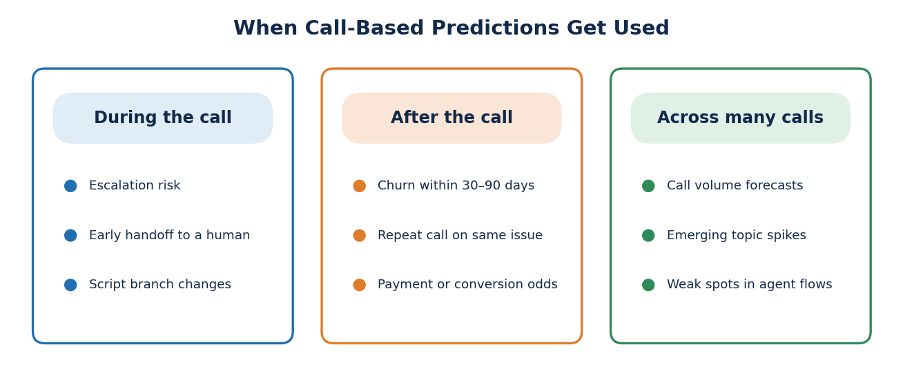
Call-based predictions work on three time horizons, each with a different destination.
Where These Projects Usually Go Wrong
The model is rarely the weak link. The data is.
Class imbalance trips people up first. If 3% of customers churn in a given quarter, a model that predicts nobody will leave is 97% accurate and completely useless. You need metrics that respect the rare class, like precision and recall at the top of the ranked list, plus enough positive examples to learn from, which can mean pooling several months of calls.
Borrowed models cause a different kind of trouble. Off-the-shelf sentiment classifiers are usually trained on product reviews or social media posts, while phone speech is messier: fragments, filler words, people correcting themselves mid-sentence. Fine-tuning on a few thousand labeled snippets from your own calls tends to beat a generic model, sometimes by a lot.
Still, drift is the trickiest issue, and with voice agents it's partly self-inflicted. Change the agent's prompt, add a new intent, or switch speech-to-text providers, and the data the model sees shifts overnight. A fallback count that signaled frustration last month might only reflect a stricter confirmation step this month. Log every agent release next to model performance, and plan to retrain after big changes.
Putting Predictions to Work
A churn score sitting in a notebook changes nothing. Predictions need somewhere to go, and there are usually two destinations. Real-time scores go back into the voice agent, triggering an early transfer, a different script branch, or a retention offer while the caller is still on the line. Post-call scores land in the CRM, where they sort a retention queue or trigger a follow-up task.
Judge the results against KPIs the business already trusts: containment rate, first-contact resolution, average handle time, CSAT, and churn itself. If a model can't move at least one of those numbers in an A/B test against current practice, it isn't ready, whatever its offline accuracy says.
Where to Start
Pick one outcome. Just one. Churn or repeat calls are usually the easiest, because the labels already exist and someone in the company owns the number. Pull three to six months of calls, join them to that outcome, and build the simplest model that could plausibly work (often gradient-boosted trees on a few dozen engineered features) before reaching for anything fancier. If the simple version finds a signal, you have a business case for the rest. If it doesn't, the problem almost always sits in the data joins or the labels, and it's better to learn that before anyone spends a quarter tuning a neural network.