
Top 7 Google Cloud partners in 2026
November 17, 2026 · 5 min read
Google Cloud is where a growing number of companies first meet AI agents at work, usually through Gemini Enterprise. But a license isn’t a deployment. Someone has to connect those agents to your data, your identity setup and your day-to-day tools.
That someone is a Google Cloud partner, and the gap between a good one and a mediocre one shows up fast. Projects stall, budgets balloon, and pilots never leave the demo stage.
We picked seven firms based on partner standing, AI delivery experience and fit by buyer size. Here’s how they compare.
What to look for in a Google Cloud partner
Start with the tier. Premier status means Google has vetted the firm’s certifications, customer results and technical depth. Then look at specializations: Gemini Enterprise, security, data and Workspace all matter if you plan to run agents at scale.
Next, ask for references that look like your organization. A partner that excels at 50,000-seat global rollouts may be a poor fit for a 400-person district or a mid-market firm. Check the support model too. Who answers the phone at 2 a.m.?
Finally, ask how they handle governance. Agents touch sensitive data, so a partner without a clear security story is a risk, not a shortcut.
1. Suitebriar
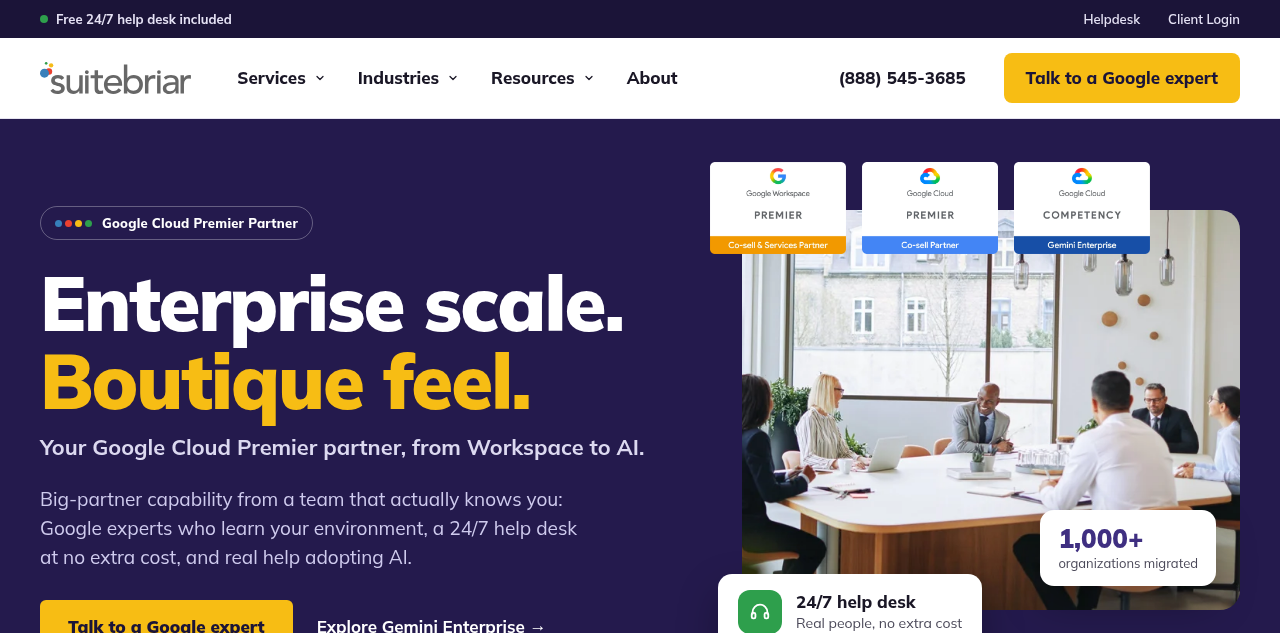
Among the top Google Cloud partners for mid-market and public-sector teams, Suitebriar stands out for being hands-on. It’s a Google Cloud Premier Partner that has migrated more than 1,000 organizations and over a million users, according to its own site.
The firm’s focus is practical. It handles Google Workspace and Google Cloud migrations, email security work such as DMARC, and a free 24/7 help desk that keeps small IT teams from being left alone after go-live.
On the AI side, Suitebriar builds custom agents on Gemini Enterprise and runs an AI Activation Workshop. The workshop includes hands-on employee training, lessons on building agents without code, and one or two working AI agents built around the company’s needs.
Suitebriar’s client base leans toward state and local government, K-12 education, real estate and private equity. It has also been named to the Inc. 5000 and holds an AICPA SOC badge.
Best for: mid-market and public-sector organizations that want a partner who stays involved after launch.
2. Devoteam
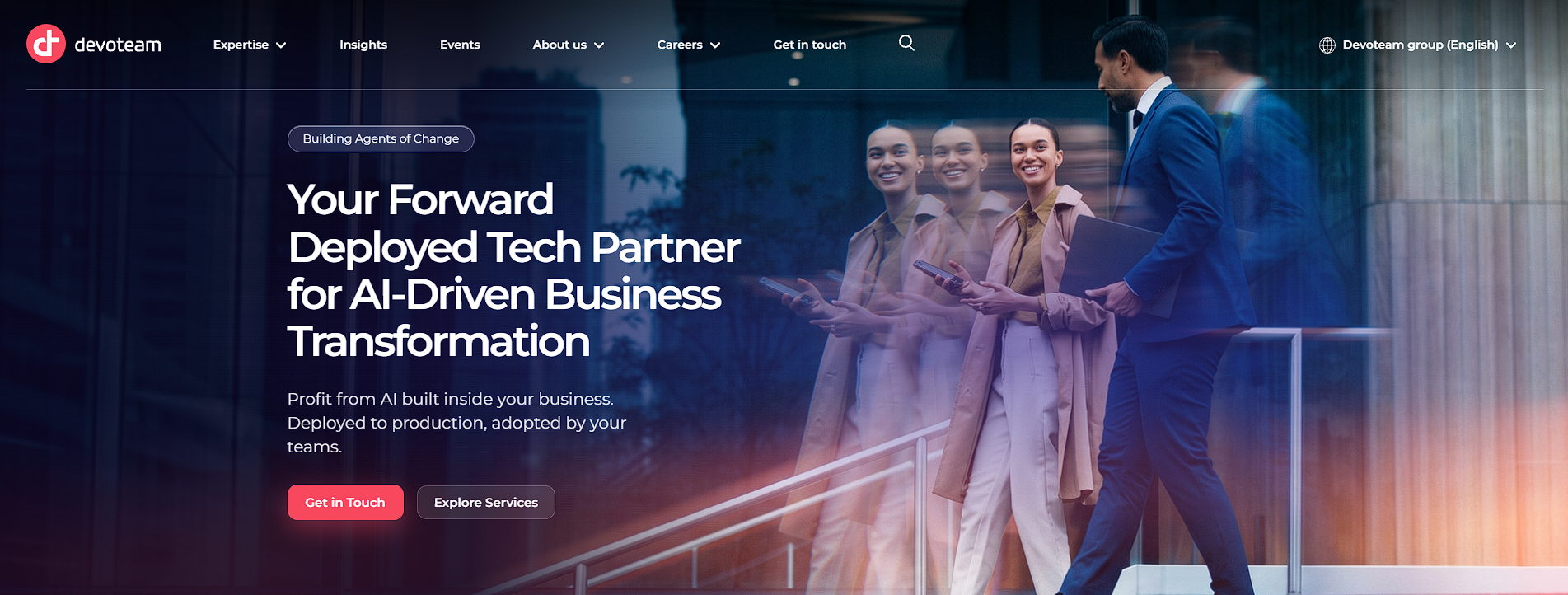
Devoteam received five Google Cloud Partner of the Year awards in 2026, according to the company’s announcement. They included the global Workspace award, plus EMEA awards for infrastructure modernisation and security.
That breadth makes it a sensible pick for organizations with operations across several European markets. The tradeoff is scale: you’re buying into a large consultancy, so expect more process than a boutique offers.
Best for: European and multi-country footprints.
3. Quantiphi
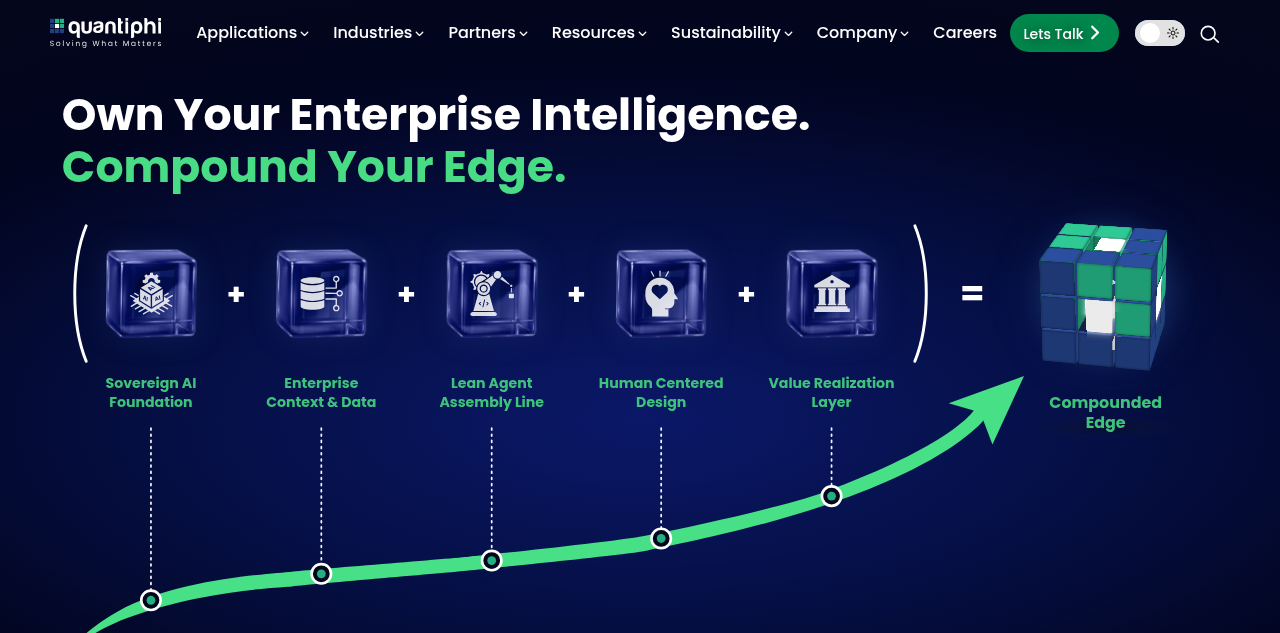
Quantiphi won Google Cloud Partner of the Year awards in four categories in 2026, per its press release. Categories covered databases in North America, Singapore as country partner, gaming services and industry solutions, and talent development in APAC.
Its roots are in AI and data engineering, so it suits teams where the data foundation is the hard part, not the model.
Best for: data-heavy projects and AI engineering.
4. SADA, an Insight company
Insight, which acquired SADA in 2023, won a 2026 Google Cloud Partner of the Year award for Global Workplace AI Transformation. SADA brings a long history on Google Cloud, now backed by Insight’s reach.
SADA holds 10 Google Cloud specializations, covering cloud migration, data analytics, security, machine learning and application development. It also helps companies modernize infrastructure and build generative AI solutions. For teams planning custom agents, Vertex AI Agent Builder is one Google Cloud tool worth discussing with a potential partner.
Best for: companies that want a large, established reseller-integrator.
5. Accenture
Accenture is a global systems integrator with a long record in large cloud transformations. It works with enterprises across industries and regions on cloud migration, data modernization and AI.
In 2026, Accenture and Google Cloud launched a dedicated Gemini Enterprise Business Group to help companies build and adopt AI agents. The group draws on Accenture's Google Cloud specialists and industry experience.
Best for: large enterprises planning complex cloud and AI projects.
6. Deloitte
Deloitte pairs cloud engineering with advisory, risk and industry consulting. That mix helps when an AI project needs strategy, change management and compliance work alongside the technical build.
Pricing and team sizes usually reflect that breadth, so it fits larger budgets best.
Best for: regulated industries that need advisory and engineering together.
7. Cognizant
Cognizant is a large IT services provider with deep work in data and analytics, and a delivery model built around scale. It’s a natural fit for organizations modernizing data platforms before layering agents on top.
Best for: large-scale data modernization.
How to choose between them
Match the partner to your size and sector first. Gartner predicts that 40% of enterprise applications will include task-specific AI agents by the end of 2026, up from under 5% in 2025. Look for a partner with experience handling projects similar to yours.
Decide what you need help with. Some organizations want support migrating to Google Cloud and managing infrastructure. Others need custom AI agents, business application integrations or employee training. Our guide on choosing a managed cloud service provider covers what to check when comparing technical support and ongoing services.
If AI agents are part of the project, decide whether an existing solution will work or you need custom development. Ready-made agents can handle common tasks, while more complex workflows may require a custom build. The AI agent selection framework can help you compare these options before discussing costs with potential partners.
Ask each firm how it would connect agents to your existing systems. Request a pilot using your own workflows and agree on measurable goals for accuracy, reliability and employee adoption. A polished demo alone won't tell you how the system will perform with your data.
Then press on governance. The NIST AI Risk Management Framework is a useful checklist to hand any shortlisted firm: ask how they'd map, measure and manage risks associated with the agents they build for you.
Finally, compare support and pricing after launch. Find out who handles updates, monitors performance and responds when something breaks. Ask about implementation fees, recurring cloud costs and support charges so you can compare the total cost rather than just the initial quote.
Conclusion
There’s no single winner for every buyer. If you want a hands-on mid-market or public-sector partner that stays close after go-live, Suitebriar leads this list. If you’re running a global program across dozens of business units, the larger integrators are built for that.
Before committing, identify the business processes you want to improve and how you'll measure results. Our guide to AI agents for marketing and operations covers common applications, from customer support to internal reporting. Use those ideas to ask partners how they'd approach your project and what results you could realistically expect.
Whichever you choose, ask for references like your own, and ask what happens after launch.