
Solving the AI Skills Gap: Finding Scale Tested Engineers for Advanced Models
October 14, 2026 · 4 min read
Building strong AI systems for real use shows a clear problem for many leaders. Thousands of people can write simple LangChain code or do a bit of work with small open-source models. But not many people have put very big models in front of millions of users at the same time. Now, as companies move from small test ideas to key business tools, there are not enough engineers who know about deep model shrinking, how to train across many computers, or how to make sure results come fast enough. This has become a big reason for slow growth.
This guide looks at why there are not many people who have these hard skills. It also explains how the best teams find these experts. You will read about how to work with remote rules, keep your ideas safe, and manage teams across the world without running into problems. Expanding your search around the world and picking to Hire Chinese Ai engineers lets engineering groups get straight to a large group of workers. These are people who have real practice in busy business settings.
Why Is Scale-Tested AI Talent So Hard to Find?
Direct Answer: Scale-tested AI engineers are scarce because operating distributed training clusters and multi-GPU inference pipelines requires hands-on experience at massive infrastructure scale—an environment only a small fraction of tech firms globally can provide.
The Gap Between Prototypes and Production
Most engineers who start working in the field know the basics of how to tweak models. But real-world places where things are built bring in tough problems. A normal class or lesson often does not show you what these problems are or how to deal with them.
- Scaling Inference Latency Reduction: Tips for maximizing inference throughput with TensorRT-LLM or your own CUDA kernels while meeting SLAs in real-time.
- Large Cluster Training and Memory Management: Techniques for organizing large clusters of GPUs across multiple nodes with fragmented memory during training.
- Quantization and Model Compression: How to make model files small with FP8 or compress models without reducing task correctness.
| Prototype-Level Developer | Scale-Tested Production Engineer |
|---|---|
| Primary Focus: API integration, wrapper scripts, basic RAG | Primary Focus: Custom CUDA kernels, distributed serving, throughput optimization |
| Scale Experience: Hundreds of daily test queries | Scale Experience: Tens of millions of daily production requests |
| Performance Fixes: Increasing server instances or timeout limits | Performance Fixes: PagedAttention, KV-cache compression, memory profiling |
| Typical Background: Bootcamps, tutorials, lightweight apps | Typical Background: High-traffic consumer platforms, top research labs |
Strategic Solutions to Bridge the AI Engineering Gap
Answer: Engineering leaders narrow the skills gap through the recruitment of individuals from technologically driven ecosystems, taking advantage of remote third-party contracting mechanisms for international hiring and scoping of systems to ensure tight data protection.
Sourcing from Scale-Dense Talent Markets
Places with big consumer internet apps have engineers who work on throughput and infrastructure problems every day. Western teams can find remote talent from these strong markets. This helps them skip tough hiring fights in their own areas.
Streamlining International Contracting
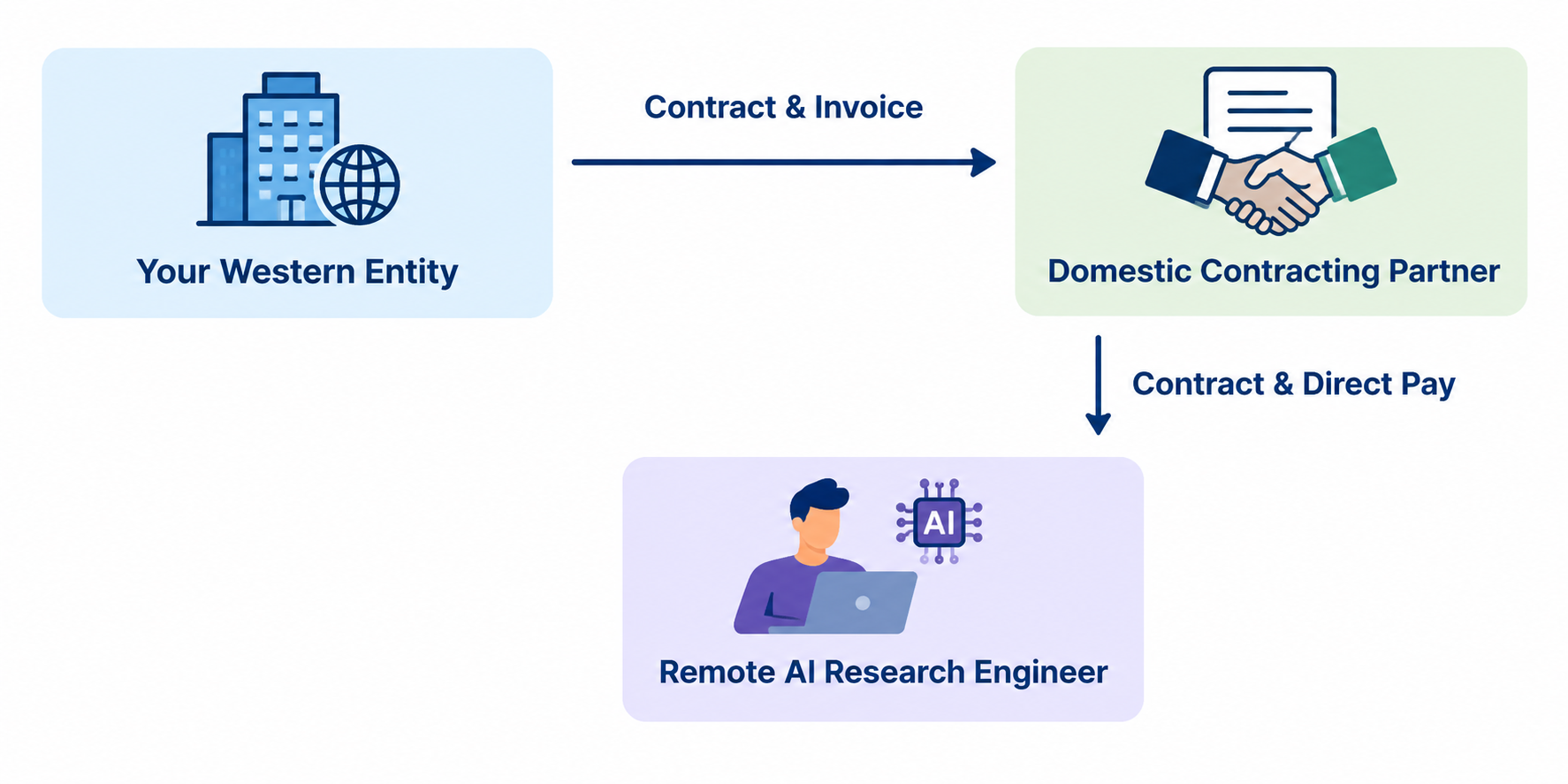
Direct cross-border work can cause many legal problems. You also have to deal with taxes in other countries and hard payroll work. When you use good local partners, things get easy. You pay one simple local bill in your own money. You also do not have to make a company in another country.
Protecting IP and Maintaining Compliance
To keep security strong when you work with offshore remote engineers, follow these main ideas:
- Chain-of-Custody IP Assignment: Make sure that your transfer process complies with the rules that are relevant to your jurisdiction while transferring the ownership of IP from the engineer to the contract company and eventually to your own organization.
- Least Privilege Access to System: Reduce access rights for different sections of codes as well as isolate primary database to make sure that engineers use only the dummy or anonymized data.
- Data Residency Security: Never allow any kind of leakage of user data beyond your geographic location to satisfy the GDPR or other similar regulations.
Common Mistakes When Sourcing Advanced AI Talent
- Research Papers vs. Coding Skills: Even though the candidate has published a lot of good papers in his/her career, that does not mean he/she has the knowledge of how to locate memory issues or has coding skills in the C++ language.
- Export Control and Data Violation: Making it easy to access your confidential model weights and user data by your offshore engineers will make you a violation case.
- Offshore Engineers as an Outsourcing Firm: Talented engineers do well when they participate in your daily meetings and code reviews. They should never have layers between you and them.
Using clear steps in remote hiring helps companies that are growing fast to Hire Chinese Ai engineers. This way, these companies can build bigger systems and run new models. They do not have to worry if there is not enough local talent.
Conclusion
Solving the problem of the AI skills gap means that you need to forget about traditional recruitment practices. First of all, you need to hire engineers who have expertise and experience in designing and developing AI algorithms in complicated situations because it will allow you to build an effective and efficient system faster. Prepare yourself to conclude agreements with third-party companies for intellectual property rights protection and security measures to provide your employees with the possibility of accessing only necessary resources. This approach will allow you to recruit competent engineers without any problems with the law and practice. Hire talented engineers and improve your AI systems.