
Lovable AI Development: From Natural Language Prompts to Production Ready Apps
September 2, 2026 · 6 min read
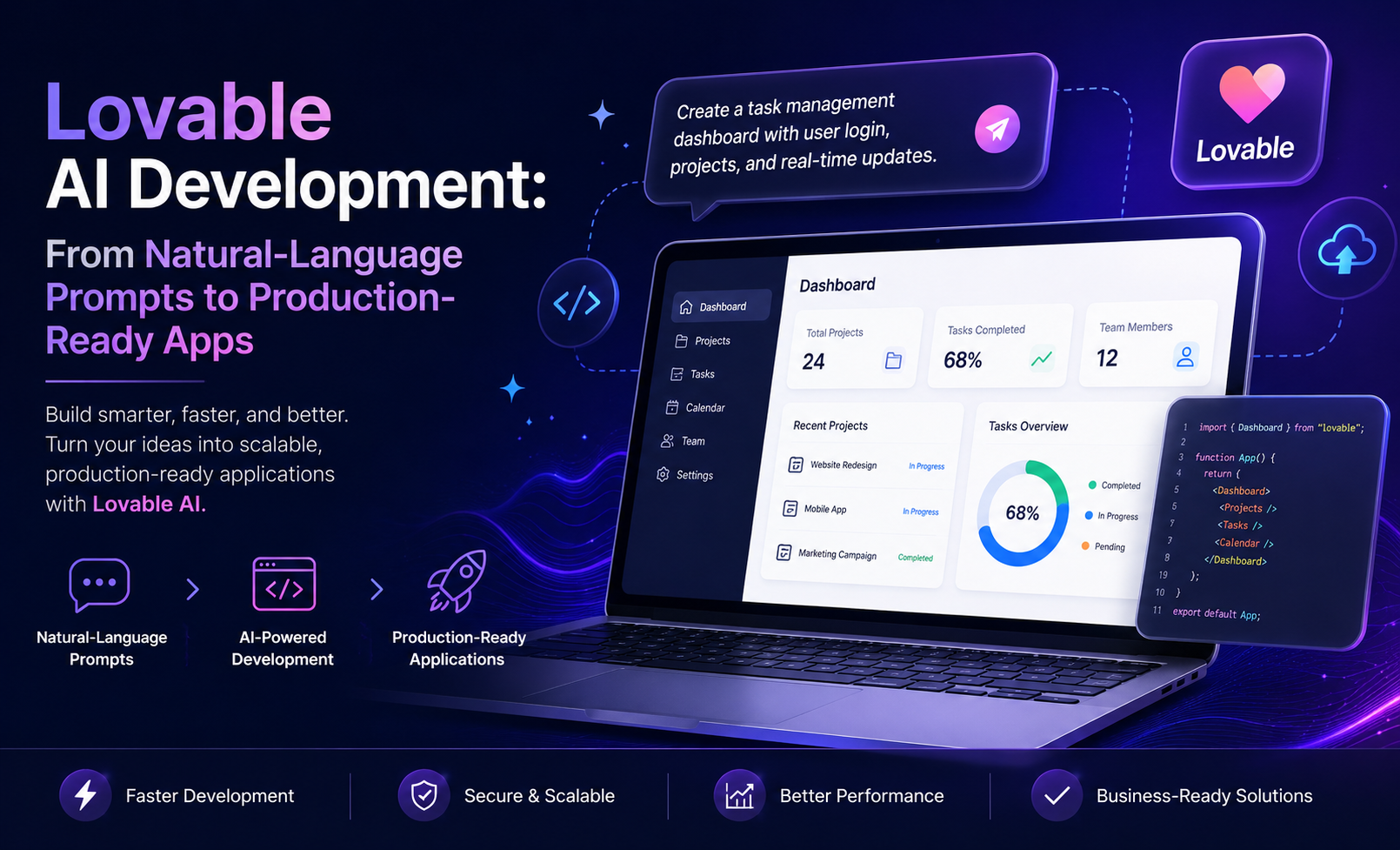
The way software is built is changing rapidly. Traditionally, turning an idea into a working application required product managers, UI/UX designers, frontend developers, backend engineers, and DevOps specialists. While this approach remains essential for complex systems, AI-powered development platforms are making it possible to move from an idea to a functional application much faster.
One of the platforms gaining attention in this space is Lovable. By allowing users to describe application requirements using natural language, Lovable can transform product ideas into functional web applications. This approach has made Lovable AI Development particularly interesting for startups, entrepreneurs, product teams, and developers looking to accelerate the software development lifecycle.
But generating an application from a prompt is only the beginning. The real challenge is turning that initial concept into a secure, reliable, scalable, and production-ready product.
What Is Lovable AI Development?
Lovable AI Development refers to the use of AI-assisted, natural-language-driven development workflows to create and refine web applications. Instead of starting with thousands of lines of code, users can describe what they want to build and iteratively guide the AI toward the desired result.
For example, a startup founder could describe an application as:
“Build a customer dashboard where users can sign up, manage their profiles, view subscription information, and submit support requests.”
Rather than manually creating every component from scratch, the AI-assisted workflow can help generate the initial interface and application structure.
The biggest advantage is not simply code generation. It is the reduction of the distance between an idea and a working prototype.
From Prompt to Prototype
The first stage of the process is translating a business idea into a clear application requirement.
Natural-language development works best when the prompt communicates more than just the visual appearance of an application. A strong prompt should explain:
- Who will use the application
- What problem it solves
- What users should be able to do
- What information needs to be stored
- Which workflows are important
- What integrations may be required
- What the expected user experience should be
For example, instead of asking an AI development platform to “build a CRM,” a more useful requirement might describe user roles, customer records, lead management, follow-ups, dashboards, notifications, and reporting.
This gives the AI enough context to produce a more useful starting point.
Why Natural-Language Development Matters
Natural-language development changes the traditional relationship between humans and software.
A product manager does not necessarily need to translate every idea into technical specifications before development begins. A designer can communicate interface requirements more directly. Developers can use AI to accelerate repetitive implementation work while focusing more attention on architecture, security, integrations, and quality.
This can significantly shorten early development cycles.
For startups, speed is particularly valuable. Instead of spending months building an idea before receiving meaningful feedback, teams can create an initial version, test it with users, identify weaknesses, and iterate.
However, faster development does not automatically mean better software.
Prototype vs. Production-Ready Application
One of the biggest misconceptions surrounding AI-assisted development is that a generated application is automatically ready for production.
A prototype and a production application have very different requirements.
A prototype may demonstrate the basic user journey. A production application must handle real users, real data, security requirements, failures, performance issues, integrations, and ongoing maintenance.
Before launching an AI-generated application, teams should evaluate several areas.
1. Code Quality and Architecture
Generated code should be reviewed for maintainability, organization, duplication, and scalability.
An application that works with 20 test users may behave very differently when thousands of users access it simultaneously.
Developers should examine whether components are structured logically, whether business logic is separated properly, and whether the architecture can support future requirements.
2. Database Design
Database structure is another critical consideration.
Poorly designed tables, relationships, indexes, or queries can create performance and maintenance problems later. Teams should review the database schema, access patterns, validation rules, and data relationships before production deployment.
3. Authentication and Authorization
Applications handling user accounts must implement appropriate authentication and authorization mechanisms.
It is not enough to create a login page. Teams need to determine what each user can access and ensure that sensitive information cannot be exposed through manipulated requests or incorrectly configured permissions.
Role-based access control can become particularly important for applications with administrators, employees, customers, vendors, or other user categories.
4. Security
AI-generated applications still require human security review.
Developers should check areas such as:
- Input validation
- API security
- Authentication
- Authorization
- Sensitive data handling
- Environment variables
- Database permissions
- Third-party integrations
- Error handling
- Dependency vulnerabilities
Security should be treated as part of development rather than something added immediately before launch.
5. Performance and Scalability
A production application needs to perform consistently under realistic workloads.
Teams should consider API response times, database queries, frontend performance, caching, asset optimization, concurrent users, and infrastructure requirements.
Load testing and performance monitoring can help identify bottlenecks before they become customer-facing problems.
The Human Developer Still Matters
AI-assisted development does not eliminate the need for experienced developers. Instead, it changes where developers spend their time.
AI can accelerate repetitive coding and help create initial implementations, but human expertise remains essential for making architectural decisions, reviewing generated code, understanding complex business requirements, identifying security risks, and planning long-term scalability.
This is why successful Lovable AI Development should be viewed as a collaboration between AI and human expertise rather than a completely automated replacement for software engineering.
The AI can help accelerate implementation. Experienced developers provide technical judgment.
Connecting APIs and External Services
Modern applications rarely operate independently.
A typical application may need payment processing, email services, analytics, CRM integrations, authentication providers, maps, AI models, cloud storage, or other external services.
Integrations should be designed carefully because they introduce additional dependencies and potential points of failure.
Developers should consider authentication methods, API limits, error handling, retries, logging, webhooks, data synchronization, and fallback mechanisms.
The objective is not simply to connect an API but to build an integration that remains reliable when external services experience delays or failures.
Testing AI-Generated Applications
Testing becomes even more important when AI is involved in development.
A functional user interface does not guarantee that the underlying workflows are correct.
Teams should test:
Functional requirements: Does each feature perform the intended action?
User workflows: Can users complete important tasks without unexpected problems?
Security: Can unauthorized users access restricted information?
Performance: Does the application remain responsive under realistic workloads?
Responsive design: Does the application work properly across desktop, tablet, and mobile devices?
Edge cases: What happens when users enter unexpected information, submit incomplete forms, lose connectivity, or repeat an action?
Automated testing can also help teams maintain quality as the application evolves.
Git and Version Control Are Essential
One of the most important practices in AI-assisted development is maintaining proper version control.
Teams should use Git-based workflows to track changes, review modifications, create branches, and recover previous versions when necessary.
This becomes especially useful when AI-generated changes unexpectedly affect existing functionality.
Version control provides a safety net and makes collaboration between AI-assisted development and human developers much more manageable.
When Should Businesses Use Lovable?
Lovable can be particularly useful when a business wants to:
- Validate an application concept quickly
- Build an MVP
- Create internal business tools
- Develop dashboards and portals
- Experiment with new product ideas
- Build customer-facing web applications
- Accelerate UI and feature development
- Reduce the time required for early development
However, businesses should evaluate the application's complexity before selecting an AI-assisted development approach.
A simple SaaS dashboard and a highly regulated enterprise platform have very different technical requirements.
For larger applications, Lovable can be part of a broader development workflow rather than the entire workflow.
From AI-Generated Code to Business Value
The ultimate goal of software development is not generating code. It is solving a business problem.
A successful application should provide a useful experience for its users, support business objectives, and remain maintainable as requirements change.
This is where Lovable AI Development can become particularly valuable. By reducing the time required to move from an idea to a functional application, teams can spend more time testing assumptions, collecting user feedback, and improving the product.
The faster feedback cycle can be a significant competitive advantage.
The Future of AI-Assisted Application Development
Natural-language software development is likely to become an increasingly important part of the development ecosystem.
As AI models become better at understanding requirements, generating code, identifying bugs, and working with development tools, the traditional development process will continue to evolve.
Developers will increasingly operate as architects, reviewers, problem-solvers, and technical decision-makers while AI handles more implementation-oriented tasks.
The most effective teams will not simply ask AI to build everything for them. They will create structured workflows where AI accelerates development while experienced humans remain responsible for quality, security, architecture, and business outcomes.
Final Thoughts
The journey from a natural-language prompt to a production-ready application is more than simply generating code. It requires planning, testing, security reviews, architecture decisions, integrations, performance optimization, and continuous improvement.
Lovable AI Development provides an exciting way to shorten the distance between an idea and a functional product. For startups, entrepreneurs, product teams, and developers, this can create new opportunities to experiment and bring software ideas to life faster.
The key is to treat AI as a development accelerator—not a replacement for engineering judgment. When natural-language development is combined with proper technical review and a production-focused mindset, teams can move faster without losing sight of reliability, scalability, and long-term product quality.