
Invideo vs. Runway: Which AI Filmmaking Platform Actually Delivers in 2026
August 26, 2026 · 7 min read
Picking an AI filmmaking platform isn't really about which one produces the single sharpest shot. Once a project needs more than one great clip, a character or a brand held consistent across dozens of shots, cutdowns for more than one platform, the tool that matters is the one that holds up past that first impressive frame.
Two names come up constantly in that specific conversation: invideo and Runway. Comparing them isn't about raw generation quality alone. Once you factor in how much of the pipeline each one actually covers, what the credit economics really cost once iteration is included, and how much manual direction you're expected to do yourself, the comparison looks different than either tool's own pitch suggests.
Invideo vs. Runway: a quick overview
Runway is a generation-and-editing specialist built around a single model family. Its Gen-4 lineup pairs with Motion Brush, inpainting, and a real editing timeline, plus Aleph for in-video editing of footage that's already been shot, earning it a reputation as "the director's tool" for frame-level manual control. It doesn't hold a project's characters or world in memory across separate generations the way a persistent context system does.

Invideo Agent takes a different approach: rather than one tool covering generation and editing for a single model family, it holds a project's characters, style, and world in memory across an entire production, routing each shot to whichever of 200-plus underlying models actually fits, then carrying that project through editing and finishing in the same workflow. With the recent Agent Two update, that routing comes paired with persistent long-term memory, a crew of specialized sub-agents, and the ability to read and act on almost any file handed to it, none of which a single-model generation tool is built to do.
Pricing: what the sticker price doesn't tell you
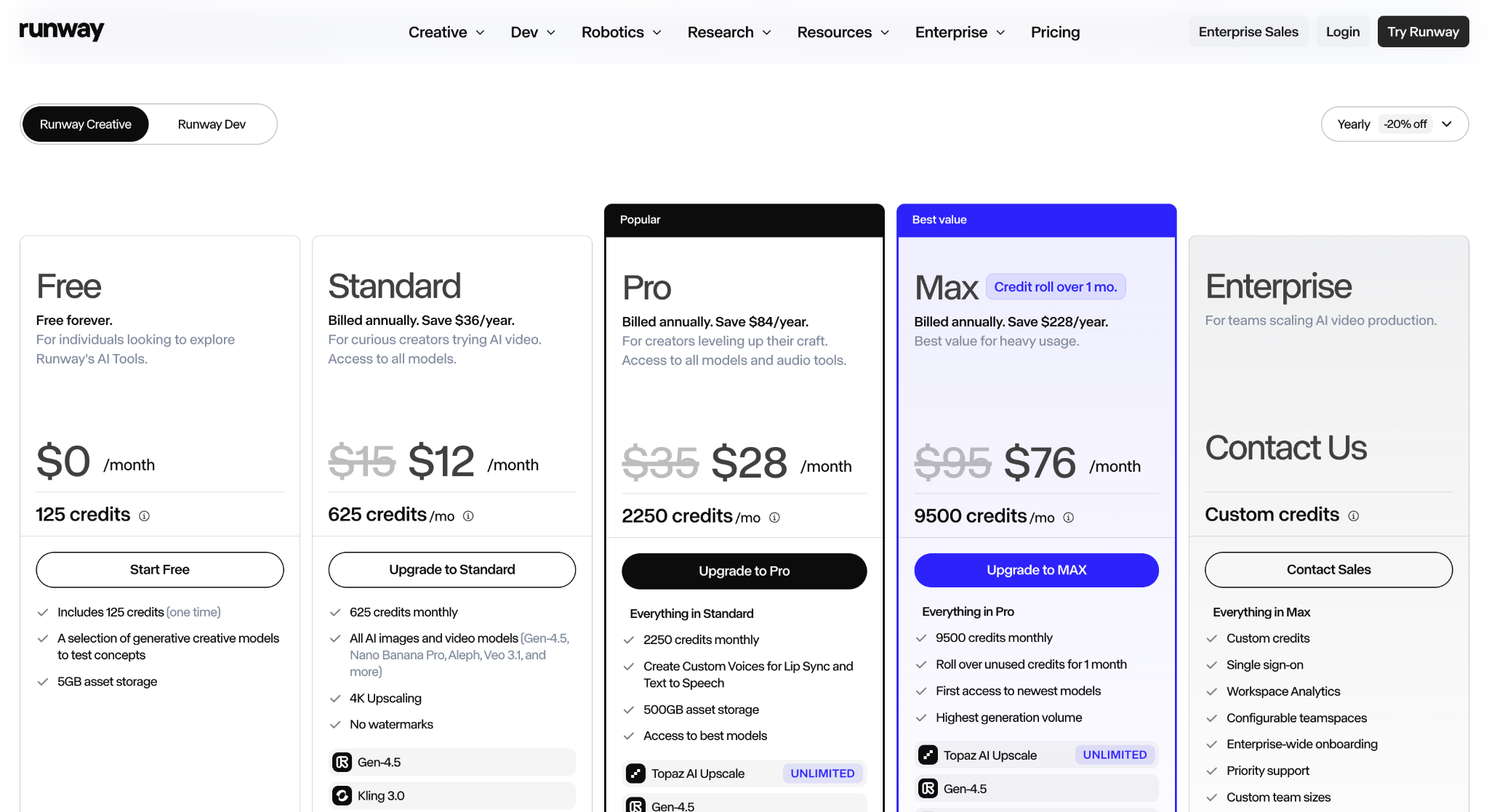
Runway charges credits per second of generated footage across its Standard ($12/month), Pro ($28/month), and Max (~$76/month) tiers, all on annual billing. The catch is that unused monthly credits don't carry over, so heavy iteration before landing a final take can burn through an allowance fast, and the real cost per usable shot depends heavily on how many attempts a project actually needs.
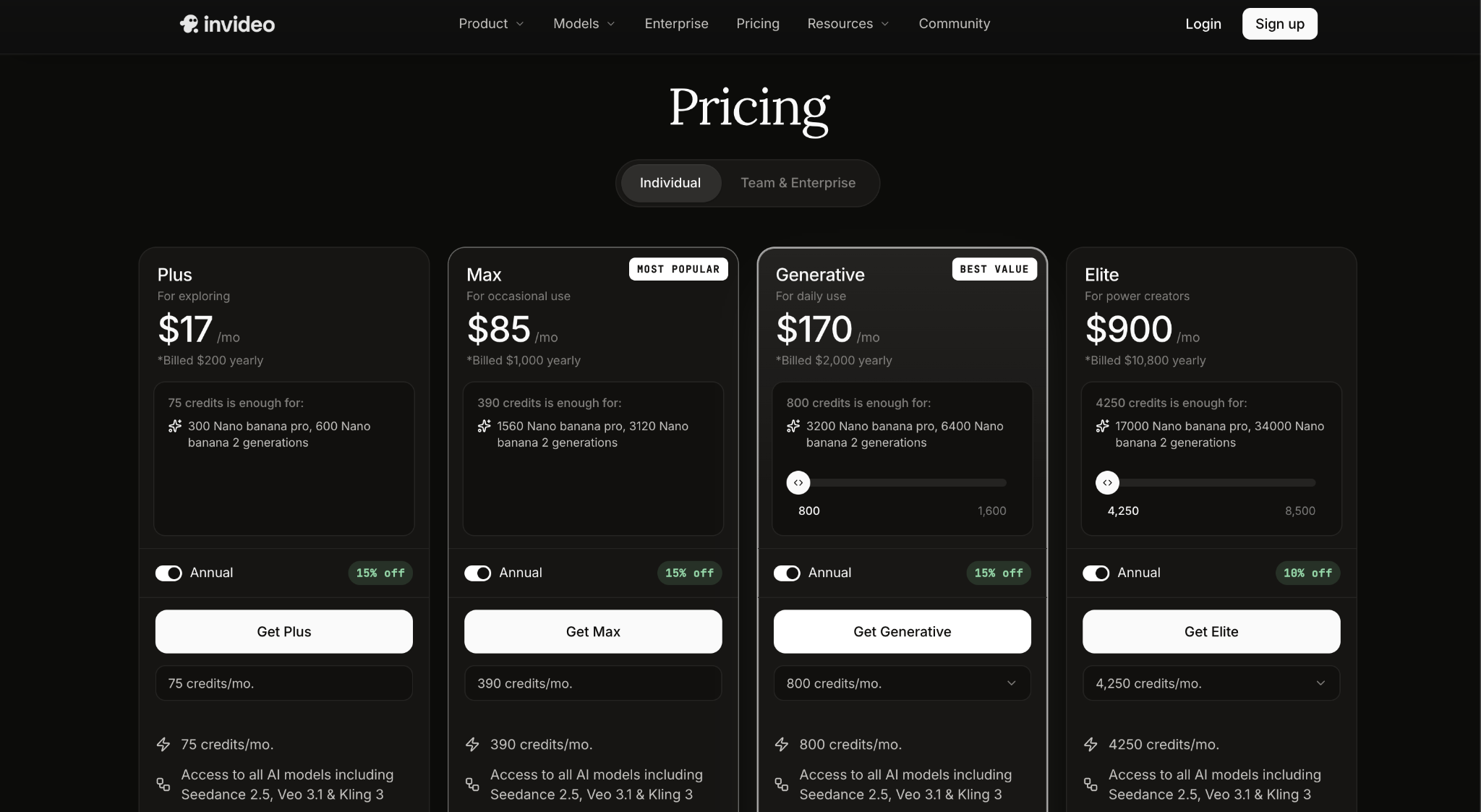
Pricing on invideo Agent runs across four annual tiers: Plus at $17/month, Max at $85/month, Generative at $170/month, and Elite at $900/month, each with a built-in annual discount and a scaling credit allowance. Every tier, including the entry one, includes the full 200-plus model library, rather than tying quality and access to how much manual iteration a project's credits can absorb.
Where invideo Agent Two actually pulls ahead
This is the part a pure generation-quality comparison misses, since these are genuinely new capabilities that push the platform past what a single-model generation tool is built to solve, because those problems live at the agent and memory level, not the model level.
Context and Briefs. Every project holds a persistent context and memory, a film's look, tone, and treatment, or a brand's guidelines and colors, with smaller briefs living inside it for each scene, episode, or campaign film. A character introduced in the first shot still looks the same hundreds of shots later, without anything being re-uploaded or re-explained. Runway's reference feature anchors identity within a set of generations, but there's no equivalent system holding an entire project's world in memory the way this does.
Expert Agents. A full crew of specialized agents, a DOP, a casting director, a costume stylist, a VFX artist, can be built just by writing each one a short job description. They brief each other automatically: telling a DOP agent to start a shot pulls in what the storyboard and costume agents already decided, and a new agent added partway through a project walks in already briefed on everything. Runway has no equivalent multi-agent structure, it's a single-model tool with manual editing, not a coordinated crew.
Agent Two has eyes. It can read almost anything handed to it, a script, a PDF, a rough cut, a YouTube link, and act on what it finds. In one real internal case, a rough cut of an in-progress short film was dropped into the agent, which mapped the footage against the shot list and flagged actual continuity errors, including a prop that had changed between two shots and a color grade running slightly off in another. It can also read a reference video's lighting or camera movement and apply that exact treatment to a new sequence.
Notebooks and Slate. Notebooks give direct, manual access to the full model library for one-off generations, while Slate is a full conversational editor built into the agent, aware of the script and approved takes, supporting familiar editing shortcuts and plain-language requests like pulling together a few shorter cuts of a scene.
Playbooks. A standing rule, always show three style options before locking a location, always prompt a specific model in a specific language, can be taught once and gets applied automatically from then on, without re-explaining it every time.
Model access and camera control
Runway's real strength here is genuine: Motion Brush gives vector-level control over how a specific part of a frame moves, Aleph edits footage that's already been shot rather than only generating new clips, and the overall toolset is built for a director who wants hands-on, frame-level control rather than describing intent to an agent.
Invideo Agent covers camera movement through named presets, a dolly, a pan, a tilt, a track, a jib, a full 360-degree orbit, applied directly to a still image or existing footage, calculating depth and parallax automatically rather than a flat digital zoom. Where it goes further is through Agent Two's reading capability: upload a clip whose camera movement you already like, and the agent reads and reapplies that exact movement to a new scene, rather than requiring a fresh manual setup for every new shot. That access also includes Runway's own model, Runway AI, as one of the 200-plus it can route a shot to, so the same underlying generation technology sits inside a broader workflow rather than only as a dedicated tool.
Precise manual control: Runway's real strength
It's worth being direct here, because it's genuine: Runway's manual controls are some of the most precise in the category. Motion Brush lets a director paint exactly which part of a frame should move and how, a level of control most agent-driven tools don't expose directly, and Aleph's ability to edit footage that's already been shot, not just generate new clips, is a specific and useful capability of its own.
That precision is exactly what "the director's tool" reputation is built on, and it suits a filmmaker who wants to make every camera and motion decision by hand rather than describing an outcome and letting a system route or interpret it. For a single hero shot where that level of manual control matters more than anything else, Runway's toolset is hard to match.
Invideo Agent covers a similar category of camera control through named presets and reference-reading, but its differentiator isn't matching Runway's manual precision shot for shot, it's that camera work happens inside the same project memory as everything else, so a moved or edited shot doesn't sit disconnected from the rest of a production's continuity.
Who each platform actually suits
Runway makes sense for a filmmaker who wants hands-on, frame-level manual direction over camera movement and motion, needs to edit footage that's already been shot rather than only generate new clips, and is comfortable managing credit economics across individual generations.
Invideo Agent makes more sense for an actual AI filmmaking project, a series, a multi-scene campaign, a brand rollout, where consistency across many shots and the ability to hand context off to a growing crew of sub-agents matters more than manually directing every individual shot's camera work.
Common mistakes when comparing the two
- Comparing the two on single-shot quality alone. Runway is built for that; invideo Agent is built for a project holding together across many shots, which is a different test.
- Ignoring Runway's credit economics until mid-production. Unused monthly credits don't carry over, and heavy iteration can burn through an allowance faster than the sticker price suggests.
- Assuming Runway's reference feature solves character consistency the way persistent project memory does. It anchors identity within a set of generations, not across an entire production.
- Overlooking that Runway's manual tools and the automated routing on invideo Agent solve different layers of the same job. Frame-level manual control and agent-coordinated production are not competing for the same use case.
- Picking the platform with broader pipeline coverage by default, regardless of the actual job. A single hero shot needing precise manual control may not need a full production workflow at all.
FAQ
What does invideo Agent Two actually add over the original invideo Agent? Persistent project-level memory through Context and Briefs, a crew of specialized sub-agents that brief each other automatically, the ability to read and act on any uploaded file including full rough cuts, a manual-control Notebooks workspace, and a built-in conversational editor called Slate.
Is Runway cheaper than invideo Agent? It depends on volume and how much iteration a project needs. Runway's Standard tier looks cheaper on paper, but credits are charged per second of generated footage and don't roll over, so heavy iteration pushes the real cost higher than the sticker price implies. Every tier on invideo Agent includes the full model library at a fixed price.
Which platform gives more precise manual control over camera movement? Runway, specifically through Motion Brush's vector-level control and Aleph's ability to edit existing footage. Invideo Agent covers camera movement through named presets and reference-reading rather than frame-level manual painting of motion.
Can Runway hold a character consistent across an entire series the way invideo Agent can? Not natively at that scale. Runway's reference feature anchors identity within a set of individual generations, but there's no persistent context engine holding character, product, and location references across an entire ongoing project.
Do Runway and invideo Agent use the same underlying generation models? There's overlap. Model routing on invideo Agent includes Runway's own model as one of the 200-plus it can route a shot to, so a team can access similar underlying technology through either platform, the difference is whether that access comes bundled inside a full production workflow or as the dedicated focus of the tool itself.