
How to Choose an AI-Ready Marketing Agency
November 6, 2026 · 7 min read
Artificial intelligence (AI) is impacting virtually every industry in some way, but perhaps none more than marketing. That’s because the very capabilities (like research, writing, editing, and creative work) that AI has automated basically make up most of what goes behind marketing.
And most marketers are actually taking advantage of them.
Salesforce's State of Marketing report says 75% of marketing organizations now use at least one form of AI for activities such as content personalization, performance prediction, and creative development.
So, brands that want to work with a marketing agency should actually want to work with an AI-ready marketing agency. And this guide explains what that looks like exactly and what to look for when choosing one.
What Does It Mean to Be an AI-Ready Marketing Agency?
An AI-ready marketing agency is one that strategically incorporates AI into its marketing services, processes, and decision-making to improve efficiency and performance.
They can use AI tools and platforms to accelerate ideation, production, and testing while cutting costs. They can leverage AI to improve outcomes for their clients.
So, being AI-ready essentially means two things for marketing agencies:
- Using AI to improve marketing performance: Applying AI to creative testing, media buying, reporting, analytics, and campaign optimization.
- Adapting to AI-driven changes: Helping brands maintain their visibility and competitiveness as AI transforms search engines, advertising platforms, and consumer behavior.
AI search is a prime example of the second one. An AI-ready, or rather AI-focused, search marketing agency would also target AI search visibility alongside traditional search. Similarly, agencies working with paid social or programmatic would account for the impact of more sophisticated bidding algorithms and how to best serve them, so the ads reach the right people and convert them.
More importantly, an AI-ready agency also has the necessary expertise, processes, and safeguards to use these technologies responsibly because AI is good, but not perfect.
Key Capabilities to Look for in an AI-Ready Marketing Agency
The best way to assess an agency's AI readiness is to examine how it applies AI across different marketing functions. Here are five capabilities to evaluate.
1. AI-Assisted Creative Development and Testing
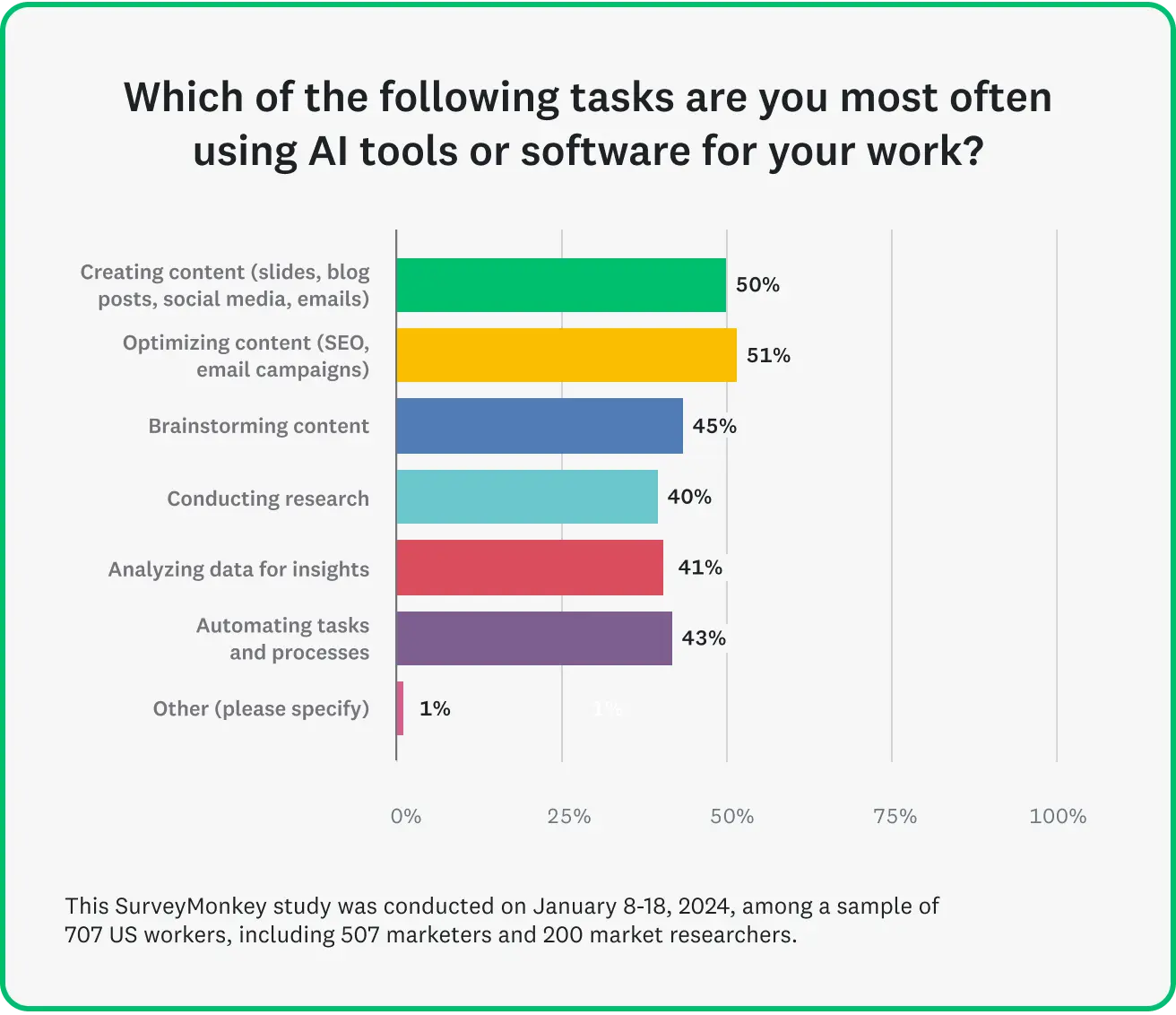
AI makes it easier to produce and experiment with different advertising creatives without significantly increasing production costs or timelines. It’s what most marketers are using AI tools for.
Source: SurveyMonkey
First, look for agencies that are best for the type of marketing you need. If you’re looking for a wide range of services, look for full-service agencies. For more specific platforms or outcomes, choose specialists.
Search for top agencies on a platform like Growth Partner Index, which reviews and ranks marketing agencies across categories.
Shortlist a few and check out their services and work on their website. A brief initial look should give you some indication if the agency is big on AI.
But you can learn more about their processes and use of AI in creative development and testing during the initial consultation. Ask how it designs experiments, measures performance, and uses findings to improve subsequent campaigns.
2. AI-Driven Media Buying and Campaign Optimization
Major advertising platforms already incorporate machine learning into targeting, bidding, and budget optimization. An AI-ready agency should know how to make these capabilities work toward your business objectives.
For example, Google's Performance Max and Meta Advantage+ automate various elements of campaign delivery and optimization.
That said, successful implementation still depends on campaign structure, data quality, conversion tracking, and strategic oversight (which is where agency expertise comes in and which is why you’re working with one in the first place).
Here’s an example of an agency using AI in ad buying. Wpromote worked with Learning Care Group to improve enrollment campaigns. They connected CRM enrollment data to Google Ads and optimized Performance Max for actual registrations. The agency achieved a reported 331% increase in registrations.
Look for details in the case studies and focus on how they achieved results. Consider the platform tools they used, or AI changes they tackled.
3. AI-Powered Analytics, Attribution, and Reporting
AI models can help make sense of your marketing spend and its direct impact on your bottom line. That capability is all the more relevant for brands that run multi-channel marketing campaigns and sometimes have fragmented data.
An AI-ready marketing agency would take advantage of AI models in its reporting. They should be able to answer complex questions now that were impossible to address a few years ago. That includes proper attribution to different platforms and campaigns, and the aggregate impact of advertising efforts.
AI can help agencies analyze large amounts of marketing data, identify patterns, detect anomalies, and generate performance insights faster.
For example, an agency might use AI-powered analytics to identify which audience segments generate higher-value conversions or detect declining campaign performance before it becomes a larger problem.
Ask how they report data, what platforms they use, or whether they have proprietary dashboards built for this purpose.
4. Agentic AI for Marketing Workflows
An AI-ready agency should also have a coherent approach to integrating AI across its day-to-day operations. They should ideally deploy marketing AI agents to automatically handle parts of operations, like monitoring competitors or tracking search performance.
These capabilities can improve delivery speed, cut costs, and free up marketing professionals to focus on strategic work.
Ask agencies how they measure productivity improvements and whether those improvements translate into faster execution, better deliverables, or greater client value.
An agency with a well-integrated workflow is generally more valuable than one using numerous disconnected AI tools without a clear strategy.
5. AI Search Visibility and Generative Engine Optimization (GEO)
AI readiness also means understanding how generative AI is changing online discovery.
Consumers increasingly use Google AI Overviews, ChatGPT Search, Perplexity, and other AI-powered experiences to research products, compare providers, and find information.
This change has implications for your brand’s organic visibility. A 2025 Pew Research Center study found that Google users clicked traditional search results in 8% of visits when an AI summary appeared, compared with 15% when no AI summary appeared.
So, obviously you want your products and services to be featured in those summaries and chatbot answers.
An AI-ready search marketing agency should understand both traditional SEO and generative engine optimization (GEO), including:
- Creating helpful, authoritative content that answers relevant customer questions.
- Improving website crawlability, content structure, and technical SEO.
- Strengthening brand authority through credible third-party mentions and citations.
- Monitoring brand mentions, citations, and referral traffic from AI-powered search tools where data is available.
Look for search-specific case studies by agencies that rank well for SEO and AI search marketing, and see how they improved ranking, authority, traffic, and linked revenue for their clients.
How Important Is Human Review and Oversight for AI-Ready Marketing Agencies?
While you’re judging your potential agency partner's AI readiness in terms of workflow, tool usage, and performance goals, also give equal weight to how they incorporate human oversight across all of it.
Although AI models across the board have made remarkable strides in the last few years, they’re still far from perfect. That’s especially important in marketing, where brand safety and reputation are on the line.
A sloppy creative can eat through the ad spend. An inaccurate claim can result in a lawsuit. And too many unnecessary automations can actually create complications in the workflows.
A reliable agency partner going all in on AI would maintain some layer of human oversight and control across different functions and deliverables.
What does that look like in practice?
- Creative quality control: Checking AI-generated content for accuracy, originality, brand consistency, and potential copyright concerns.
- Strategic decisions: Ensuring human specialists oversee channel selection, positioning, targeting, and budget decisions.
- Performance validation: Verifying AI-generated reports and recommendations against reliable campaign data.
- Final approvals: Establishing clear responsibility for reviewing and approving client-facing deliverables.
The agency should also be transparent about which activities are automated and where human judgment is involved.
Review the copy describing their services to see how they manage human oversight and, where needed, ask directly.
How Does the Agency Handle Data Privacy and Protection?
The use of AI tools in marketing has increased concerns about privacy and data protection. Many brands rely on and process customer information, campaign performance data, and proprietary business materials in different aspects of marketing.
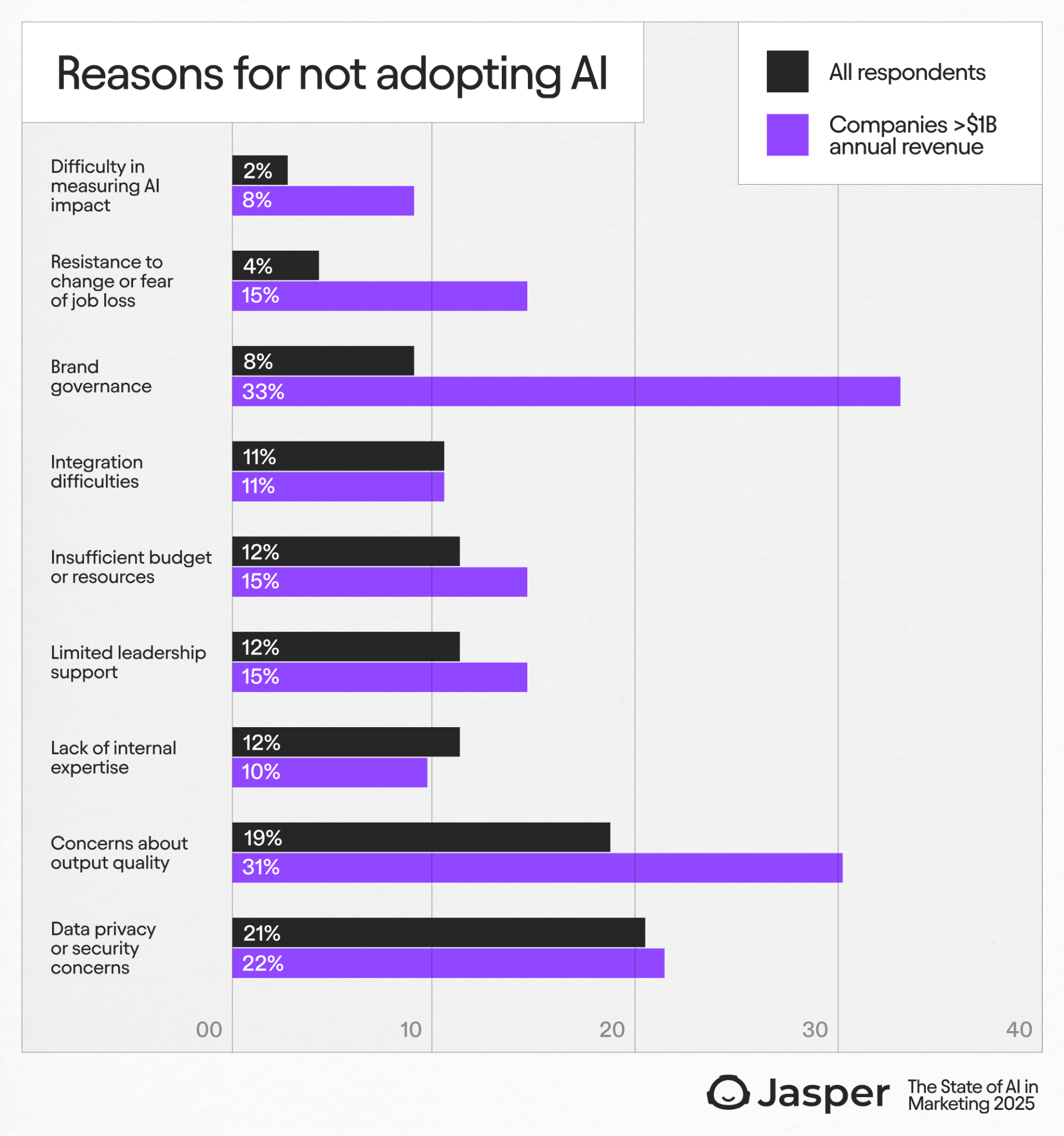
In Jasper's 2025 State of AI in Marketing report, data privacy was the most frequently cited barrier to scaling AI adoption among surveyed marketers, at 21%.
Source: Jasper
If you’re working with an external partner for marketing and advertising, you’d be providing access to internal data and platforms. And those partners might be connecting that data with their own tools (bought or proprietary).
It’s incredibly important to ensure your marketing partners understand and honor privacy and data protection requirements through necessary security protocols and measures.
Here’s what you should consider:
- Data handling policies: Does it have clear restrictions on uploading confidential client information to public AI tools?
- Regulatory compliance: Does it understand applicable requirements under GDPR, CCPA, and other relevant privacy legislation?
- Third-party vendors: Does it review AI providers' data retention, security, and model-training policies?
- Access controls: Does it restrict sensitive information to authorized personnel and systems?
- Ownership and confidentiality: Are data ownership, intellectual property rights, and permitted uses of client information clearly defined?
Ask prospective agencies for their AI usage policies and relevant contractual safeguards before sharing sensitive data.
Red Flags to Watch Out for When Choosing an AI-Ready Marketing Agency
Not every agency promoting AI-powered services has the expertise to deliver meaningful results. Watch for these warning signs when comparing potential partners:
- Vague claims about AI expertise: The agency calls itself ‘AI-powered’ but can’t explain which technologies it uses or how they improve performance.
- Overreliance on AI-generated content: It prioritizes content volume over originality, accuracy, and relevance to your audience. (Look at the actual creatives to make that call)
- No proven results: It can’t provide case studies, measurable performance improvements, or practical examples of AI implementation.
- Lack of transparency: It refuses to explain its AI workflows, data handling practices, or the extent of automation.
- No built-in human oversight: There’s no human review layer in the deliverable chain (especially for strategy and final approval).
- Unjustified AI-related fees: It charges additional fees for AI capabilities without showing how those capabilities improve quality, efficiency, or business outcomes.
- Guaranteed AI search visibility: When looking for a GEO agency, don’t fall for guaranteed rankings, citations, or brand recommendations in ChatGPT, Google AI Overviews, or other generative search experiences.
Final Thoughts: Choose AI Capabilities That Deliver Business Value
There’s a lot of noise around AI, especially in the market space. Many marketing agencies just throw around the word without incorporating the technology in a way that helps them and their clients.
Those are the type of partners you want to avoid. And you can do that by vetting agencies in how they describe what they do, the tools they use, the work they’ve already done, and how they’ll use AI tools specifically for your projects.
Keep in mind the whole point of AI in marketing, whether for creation, buying media, or automating simple tasks, is to improve results at the end of the day. That should be your agency partner's focus and motivation.