
How Citation Mapping Delivers Free AI Visibility and Enhances Your AEO Visibility
August 28, 2026 · 5 min read
How Citation Mapping Delivers Free AI Visibility and Enhances Your AEO Visibility
Today, search engines have moved beyond presenting ten blue links. It is now the era of Large Language Models (LLMs), generative answer engines such as ChatGPT by OpenAI, Perplexity, Google AI Overviews, Gemini, and Claude, which dominate the landscape. When you ask tough questions, these engines will not simply search for websites containing information. They will collate relevant sources on the internet in real time. They will give you an answer, instructions, and provide proper sourcing of the information.
To help people find your brand, you need to move from using old-fashioned Search Engine Optimization (SEO) to Answer Engine Optimization (AEO). The main thing here is Citation Mapping. This is a plan that helps make your content the main and trusted thing that AI uses, talks about, and tells others to read. If you get good at this, your brand gets free AI visibility and keeps its spot in the online market. This means you get lasting reach on all the big platforms that use new AI tools.
What is Citation Mapping in AI Search?
Citation Mapping is the smart way of making your content match how retrieval engines like Retrieval-Augmented Generation (RAG) find and pull information. It is not like older SEO that focuses on keywords and how many backlinks you have. Citation Mapping is about making what you talk about clear and easy to find, setting up your content in a way engines can read, and making sure your content matches what most people say.
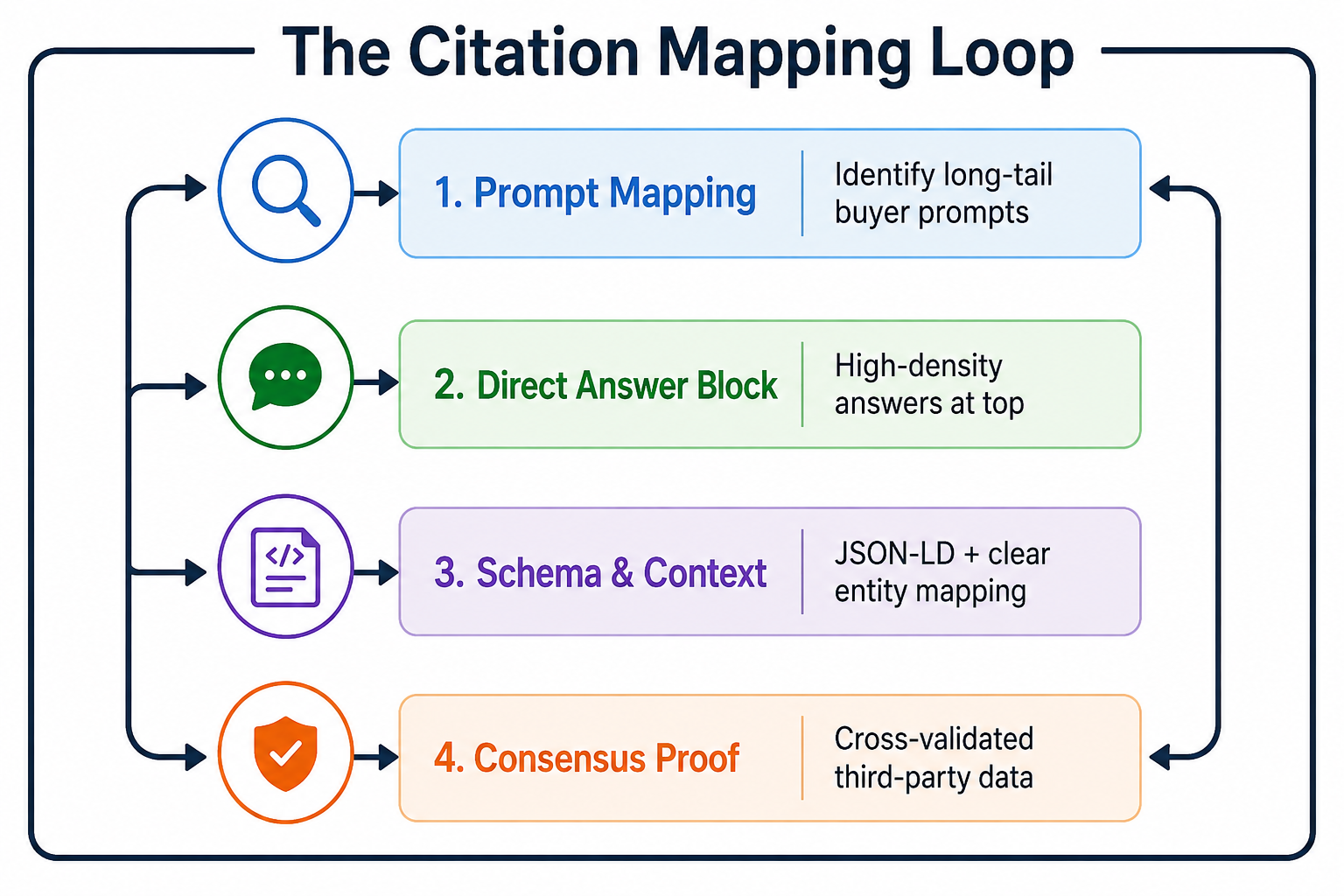
When an AI engine works with a question, it splits the prompt into parts and smaller questions. It checks the top pages on the web. It does not read big blocks of text. It looks for clear and facts. Citation Mapping organizes your content so that AI tools see your site as the best and most trusted place to get answers.
Core Mechanics: How Citation Mapping Drives Answer Engine Optimization
AI platforms check content by looking at four main parts:
1. Inverted Pyramid & Answer Density
AI systems try to pull data fast and easily. When you put clear and packed summary blocks right at the top of your sections, crawlers can pick up details or numbers right away. This makes it much more likely for you to get a footnote citation.
2. Entity Recognition and Knowledge Graphs
Search algorithms look at things in the real world (like people or groups) and how they connect. If you use Schema markup like Organization, TechArticle, or FAQPage, and clear subject details, there is less confusion. This helps large language models link your brand with the right topics in your field.
3. Cross-Source Consensus & E-E-A-T
Prior to citing an engine, it examines the claims made through external signals. These could include reviews by other people, news articles, or any mentions of your brand that don’t link back to you. When your knowledge is consistent with that of others, you demonstrate high levels of E-E-A-T.
4. Semantic LSI Keyword Clustering
Answer engines of today leverage Latent Semantic Indexing (LSI) and vector embedding. These are used in order to facilitate the matching process of people’s needs. If you use terms that are interconnected such as generative search, retrieval-augmented generation, knowledge graphs, contextual relevance, and brand authority, then your content is optimized for all kinds of search intents.
Comparison: Traditional SEO vs. Answer Engine Optimization (AEO)
| Optimization Factor | Traditional SEO | Answer Engine Optimization (AEO) |
|---|---|---|
| Primary Goal | High search result rankings & website clicks | Direct citation, inclusion in AI summaries, & zero-click trust |
| Content Structure | Long-form, narrative engagement | High-density fact blocks, inverted pyramid, structured schema |
| Validation Signal | PageRank & inbound hyperlink anchor text | Cross-platform entity consensus, co-mentions, & original data |
| Target Query Type | Short-tail & mid-tail search keywords | Natural language prompts, intent clusters, & follow-up questions |
Step-by-Step Blueprint to Execute Citation Mapping
- Check Current AI Visibility: Search in ChatGPT, Perplexity, and Gemini for prompts within the core part of your industry. Find out which of your rivals the AI brings up as main sources.
- Make Prompt-to-Source Maps: Link your main buyer questions in a clear way to special asset pages set up on your website.
- Use Clear Structural Markup: Add JSON-LD structured data with strong keywords and bulleted short points. This helps machines read your site without trouble.
- Publish Your Own Research: Put out your own numbers, examples, or survey results. AI tools put more weight on these data points because they cannot get them from somewhere else.
- Get Other Sites to Cite You: Set up listings, customer reviews, and news pieces. Keep your brand description the same across these. This helps build trust between sources.
FAQ
How does Citation Mapping differs from classic SEO?
Classic SEO is about getting your site on top of the search result rankings with the help of long-form narrative text and backlinks. On the other hand, Citation Mapping (AEO) means getting cited as a zero-click AI summary or getting a direct footnote citation thanks to high-fact-density blocks.
Why is the inverted pyramid so important for AI Engines?
AI engines need fast data extraction and they always seek for short summaries that will allow them to scrape necessary data without any additional efforts. The inverted pyramid structure makes your content easy to analyze for LLMs and scrape required facts.
What is the role of schema markup in Citation Mapping?
Structured data, especially in JSON-LD format (Organization, TechArticle, or FAQPage), helps to define how entities in the real world are related. This structure gives you less room for ambiguity, which means that AI engines will understand how your brand fits into the industry.
How does the cross-source consensus impact AI citation?
Generative answer engines look for unlinked brand mentions, external reviews, and news about your company in order to verify your claims. Consistent data across multiple platforms proves that your content has high E-E-A-T and increases the chances of getting cited.
How to execute a Citation Mapping strategy?
First of all, you have to audit your brand's current presence in AI tools and map out top user prompts to relevant resource pages. Then use JSON-LD, publish proprietary research data and maintain consistent brand data across multiple platforms.
Securing Long-Term AI Authority
Generative engines now play a bigger part in online searches. Because of that, just tracking rankings is not enough anymore. When you put a citation mapping plan in place, it turns your digital content into a reference hub that machines read easily. This helps you reach more people and keeps your AEO visibility strong for a long time.