
How AI Powered Enterprise Applications Are Changing Business Operations in 2026
September 22, 2026 · 6 min read
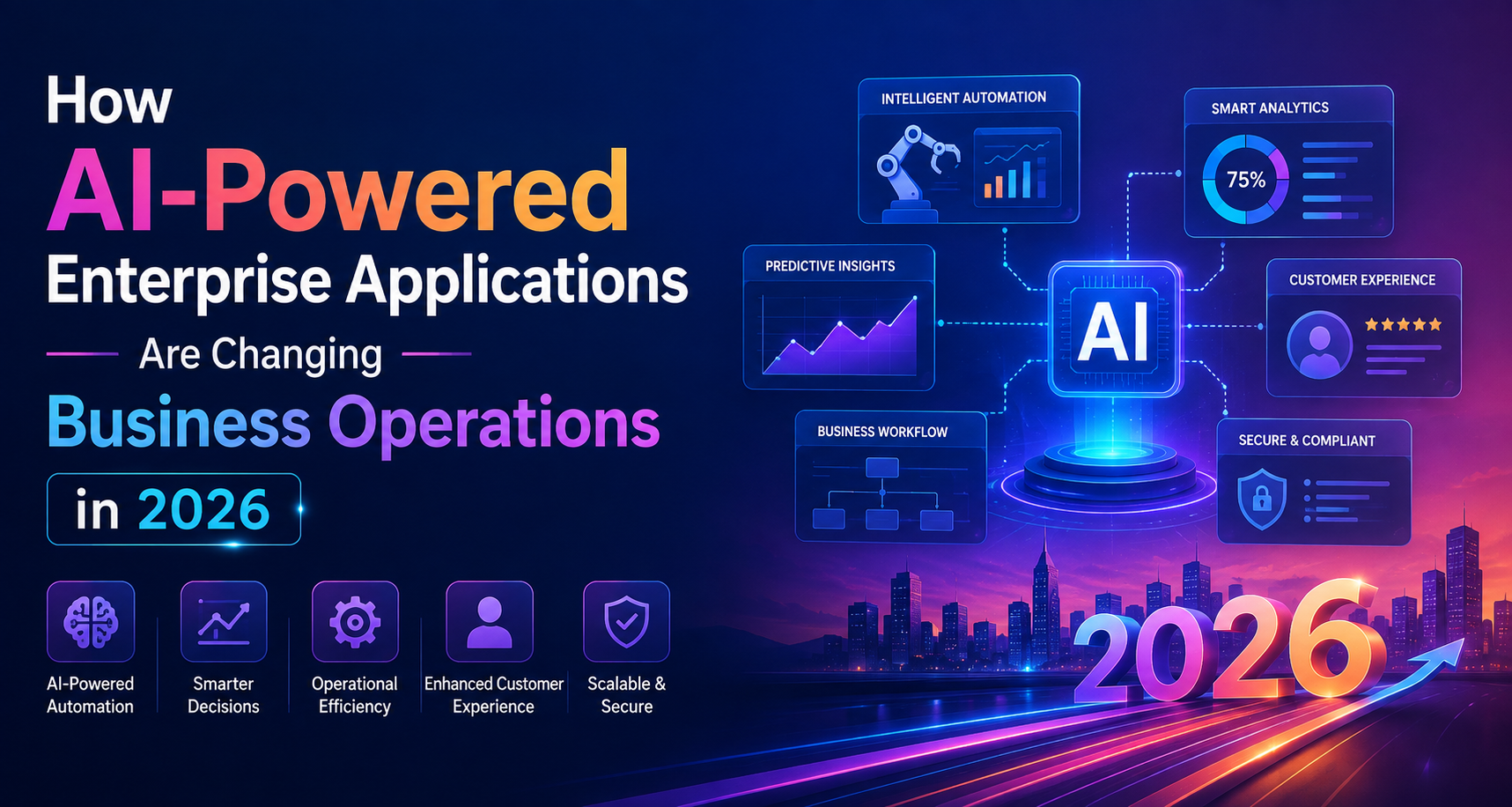
With constant demands for speedy performance, a cut in operating costs, and an improved customer and employee experience, businesses will be taking advantage of artificial intelligence in 2026 and making it part of their mainstream operations.
This technology is already helping organizations to implement automation of monotonous processes, gain insights from raw data, support their teams, and make decisions very quickly. Different companies from industries such as finance, healthcare, retail, and logistics are now incorporating AI functionality into existing apps.
With the advent of AI, companies are changing the way they approach the software development process. Now they frequently get in touch with companies offering enterprise app development services that partner with them to develop applications that will have both traditional business functions and AI automation features.
What Are AI-Powered Enterprise Applications?
These are solutions in the form of business software that integrate AI technology in order to execute various tasks, analyze data, detect different patterns, and provide recommendations. While traditional applications usually operate by using predetermined algorithms, AI-based solutions can process enormous chunks of information and adapt themselves to the changing environment.
For instance, an application that makes use of AI in customer service can analyze customer queries and provide solutions. In a similar manner, inventory control systems that involve AI can scrutinize market trends and make stock predictions.
Such applications do not in essence replace human workers. They only aid the staff to perform their work more swiftly and concentrate on important tasks that require human intellect.
How AI Is Changing Business Operations in 2026
AI influences myriad aspects of business operations, some of which are outlined below.
1. Automating Repetitive Tasks
The employees spend a lot of time on the repetitive operations such as input of data, paperwork processing, bills handling, and report generation, notwithstanding the importance of the work.
Using AI, one can automate many such labor-intensive activities. For example, in finance, there are AI-based applications that can substitute manual data processing.
2. Faster Business Decision-Making
Businesses produce vast volumes of data on a daily basis. However, data collection is useful to organizations only if they can convert the collected data into valuable insights.
Artificial intelligence-based enterprise applications can analyze business data efficiently and reveal trends, anomalies, and opportunities.
Using the information obtained, managers can make informed decisions in regards to sales, stock, marketing, workforce planning, and other business processes.
Decision-makers can access relevant information from their business applications instead of waiting for long manual reports.
3. Smarter Customer Service
Expectations regarding customer service are rising steadily. Consumers expect prompt replies and efficient support through various communication channels.
AI-powered enterprise solutions can help in providing better customer service by means of such tools as intelligent chat bots, automatic ticket classification systems, recommendation systems, and customer sentiment analysis.
For instance, the AI system can check a client’s message, recognize the problem, find relevant information, and suggest a reply to the support manager.
Thus, companies can maintain shorter delivery times and leave complex issues to the human agents.
4. Better Employee Productivity
AI is becoming a workplace assistant for employees.
Enterprise applications can leverage artificial intelligence to create summaries of information, generate reports, query the intranet, classify tasks, and respond to queries regarding various organizational issues.
Thanks to AI systems, employees will no longer be required to spend long hours looking for basic information in different systems.
With the implementation of AI in existing business software, employees will receive valuable support without needing to switch between applications all the time.
5. Improved Supply Chain Management
The supply chain is a complex mechanism consisting of many elements, such as suppliers, warehouses, means of transport, stock of goods, and customer requirements.
AI can provide forecasts based on the analysis of past sales, market situation, seasonal factors, and other business-related information.
Companies can obtain the necessary forecasts and learn about potential supply chain issues thanks to AI functionality embedded in enterprise applications.
AI-Powered Enterprise Applications Across Different Industries
The usage of AI technologies in a company is not limited to a single branch of business. Different companies from various domains have found practical ways to implement intelligent applications.
Healthcare: Applications powered by AI can help organizations with patient scheduling, administration, communication with patients, and analysis of data.
Retailing: AI has the capability of assisting businesses in product suggestions and demand forecasting, customer assistance, and custom marketing.
Banking and finance: Financial institutions can utilize AI technology for fraud detection, customer service, paperwork handling, and finance analysis. Neontri's banking software development team can help financial institutions explore AI-driven solutions that improve operational efficiency, strengthen fraud prevention, and streamline customer-facing services.
Production: AI could be widely used for predictive maintenance, quality control, production planning, and operations control.
Logistics: Businesses can adopt this technology to make route planning and shipping and warehouse operations more efficient.
The way AI will be implemented will depend on the type of business, information used, and goals achieved.
Key Features of AI-Powered Enterprise Applications
Modern enterprise applications can include several AI-based capabilities. Common features include:
- AI-powered chatbots and virtual assistants
- Predictive analytics
- Intelligent search
- Automated document processing
- Personalized recommendations
- Workflow automation
- Natural language processing
- Fraud and anomaly detection
- Predictive forecasting
- AI-powered reporting and dashboards
There is no need for businesses to deploy all of the features simultaneously. Taking the time to identify the operational issues where AI could generate tangible benefits is a smarter move.
Benefits of Adopting AI in Enterprise Applications
The implementation of AI solutions can bring a number of operational advantages.
Higher productivity levels: Automation reduces the time spent by employees on repetitive work.
Lower operational burden: AI can take care of certain repetitive processes without human intervention.
Better insights: Large datasets can be processed with the help of AI, whereas the number of patterns can be easily identified.
Faster customer support: AI power ensures immediate responses to common customer inquiries.
Better flexibility: Automated processes allow businesses to cope with increased workload without raising the amount of manual labor.
More customization: The AI solution makes it possible to analyze customer behavior and provide better services accordingly.
Challenges Businesses Need to Consider
Nevertheless, the use of AI presents certain obstacles. Because the enterprise application deals with private information about business processes and clients, the issues regarding security and privacy have to be resolved.
In addition to that, given the fact that the effectiveness of any AI application is based on the quality of data, sufficient attention should be paid to it. AI requires high-quality and complete data in order to produce meaningful results; otherwise, AI will provide results that cannot be trusted.
Another area for consideration is integration. All AI functions should be integrated into the existing software systems instead of forming independent processes.
Moreover, training is significant as well. The employees should be aware of the way the functions of AI work and where to use them, as well as when the human confirmation is needed.
How Businesses Can Prepare for AI-Powered Applications
Those companies that want to use AI should start with identifying a real business problem rather than trying to implement AI because it is popular today.
To solve this problem, the company needs to find the repetitive processes that require data and then assess the quality of the data they have.
Therefore, businesses need to select suitable AI technologies, as well as establish their security requirements. By working on a smaller use case, it’s possible to get easy measurement of results.
With the help of an experienced development partner, companies will be able to make plans about integrations, create custom features, test the app, and later scale the solution.
The Future of Enterprise Applications
AI will soon become a part of enterprise applications. The arrival of future applications characterized by automation, analytics, natural language interfaces, and intelligence in one package is expected.
It's important to note that it’s not enough to add AI technology to a currently existing application. Thus, the future is in applications that will be able to understand the processes and provide help to the employees in questions with data processes and decision-making needs.
As the progress in technology continues, and as more companies engage with it to meet new business challenges, the importance of sound data policies, proper security measures, and human intervention and governance for the development of their enterprise applications is going to increase.
Conclusion
The future of business operations can be seen in the use of AI-driven enterprise applications in 2026. They enable companies to automate mundane tasks, gather and analyze data, and provide better customer service, while also creating better conditions and support for employees.
Achieving the best results will not be possible without the combination of AI with business processes, security measures, and human managers.
All businesses interested in the modernization of their operations need to make the right investments in enterprise application development to ensure maximum efficiency and achieve more ambitious long-term digital goals.