
How AI Is Transforming Executive Search and Leadership Recruitment
November 6, 2026 · 7 min read
Artificial intelligence (AI) is dramatically influencing recruitment, including executive search.
Executive recruitment usually relies on extensive research, established professional networks, and the judgment of experienced consultants. Those services and methods remain important, but AI is changing the processes behind the scenes.
Of course, speed is a major benefit of incorporating AI into the recruitment process, in general, but in executive headhunting, quality may trump speed. After all, your choice of a CEO, CFO, or other leader could determine the course of the business.
This guide explores how AI affects executive search, in particular, and how companies and their recruitment partners can ensure AI use doesn’t compromise quality, reliability, or regulatory compliance.
AI’s Adoption in Recruitment and Executive Search
Recent data makes it crystal clear that recruiters and HR leaders are placing their bets on AI across the board.
SHRM's 2025 Talent Trends research says 51% of organizations use AI to support recruiting activities. Among those using AI for recruitment:
- 66% use it to write job descriptions.
- 44% use it to screen resumes.
- 32% use it to automate candidate searches.
- 89% report that AI saves time or increases efficiency.
Similarly, LinkedIn's 2025 Future of Recruiting report found that 37% of recruiting organizations were actively integrating or experimenting with generative AI, up from 27% the previous year.
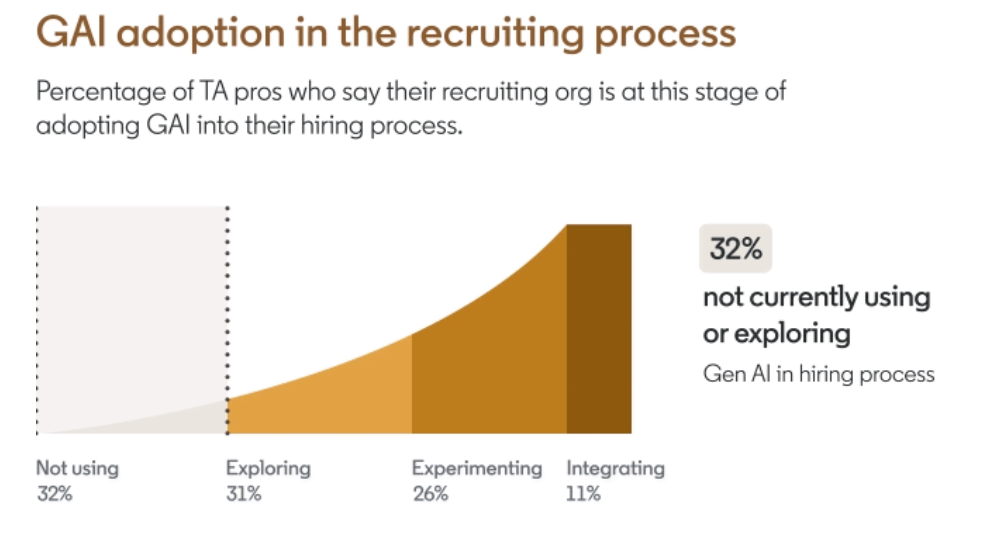
Source: LinkedIn
Those already using or testing the technology reported saving approximately 20% of their workweek on average.
Although these statistics cover recruitment broadly, they do show how AI is changing talent acquisition.
Beyond generative AI, recruiters are also turning to AI agents for recruitment to handle repetitive tasks autonomously and improve candidate experience.
In executive search, AI has particular value because it involves extensive market research, sequential evaluation, and confidential engagement. AI can handle much of the initial research and information processing, allowing consultants to focus more on strategic advisory, relationship-building, and assessing leadership suitability.
How AI Is Improving Candidate Sourcing and Talent Market Mapping
One of AI's most significant contributions to executive search is making it easier to identify potential leaders and understand the available talent market.
AI Models Can Help Identify Leadership Talent Beyond Traditional Networks
AI-assisted sourcing tools can analyze professional profiles, career histories, company information, and other relevant data to identify executives who meet specific criteria quickly and at scale.
They can also recognize transferable skills and experience that simple keyword searches might overlook.
That’s especially important for industries with executive talent shortages, where quality candidates shouldn’t be overlooked.
For instance, an organization searching for a chief operating officer in manufacturing might discover executives from logistics or supply chain businesses who have successfully managed comparable operational challenges.
AI Models Can Build More Comprehensive Talent Market Maps
Talent market mapping involves systematically identifying and analyzing the executives, organizations, and career paths relevant to a particular leadership position.
That’s usually the first step in the executive recruitment process. And this step can take days to weeks, which means the search doesn’t even begin for some time.
Well-trained AI models can speed up this process by bringing together information on organizational structures, executive career moves, professional experience, and industry trends. Recruiters can essentially train models on their knowledge and existing case studies to speed up the process.
Then, search consultants can use these insights to:
- Identify leadership talent across competing and adjacent industries.
- Analyze the geographical distribution of qualified executives.
- Understand the availability of candidates with specialized skills.
- Identify potential successors for critical leadership positions.
- Advise clients on realistic hiring requirements and talent availability.
How AI Supports Executive Candidate Evaluation
AI is embedded in every stage of executive headhunting and recruitment, and it's most useful in candidate evaluation.
Once recruiters shortlist potential leadership candidates, AI models can assess them faster by sifting through resumes, public profiles, and other evidence of capabilities, achievements, and fit for the organization.HR managers and recruiters don’t need to parse that information manually.
AI can support several parts of this evaluation process.
- Leadership assessments: AI tools can identify and assess competencies like strategic thinking, decision-making, communication, and the ability to lead organizational change. They can measure those capabilities against a set of criteria/ratings.
- Structured interviews: AI can evaluate interviews and even conduct them (L’Oreal has explored that). Plus, AI can generate relevant interview questions, transcribe conversations, summarize responses, and organize evidence against assessment criteria to basically move the interview process forward faster.
- Reference checks and background research: References offer valuable insights into how executives actually perform in leadership positions. AI can help search consultants develop reference-check questions, organize feedback, and identify recurring themes across multiple references.
Why Human Judgment Still Determines Senior Leadership Hires
AI can analyze career information, assessment results, and professional achievements, but it can’t fully understand what makes a particular leader right for an organization.
That’s where professional executive recruiters come in because they understand the nuances that AI models easily miss.
For instance, Alpha Apex Group, a retained executive search firm, bases its search on understanding the complexities and challenges of the business. So, their professionals are not simply matching competencies but evaluating candidates through the lens of where the business, market, and the overall industry are headed.
Besides acumen, human oversight is also important to prevent bias and mistakes. Historical accounts (like the infamous Amazon incident) show AI models can carry over bias in candidate selection and recommendations. That, of course, has to be dealt with at the training level but also in the output, with an expert looking at how and why a model recommended a person.
To put it simply, executive appointments require judgments that extend beyond measurable qualifications. They also need to consider strategic and organizational fit and understand the context behind achievements to make the final call.
And executive search also includes relationship management, maintaining confidentiality, and negotiating terms and compensation, all things that benefit from direct human involvement and contact.
Risks and Challenges of Using AI in Executive Recruitment
Despite its advantages, AI introduces risks that executive search firms and hiring organizations must manage carefully.
Algorithmic Bias and Fairness
We already discussed this. AI systems trained on historical recruitment or career data may reproduce existing patterns of discrimination.
A model trained on profiles of previously successful CEOs might disproportionately favor candidates from certain educational institutions, industries, or demographic groups. This could unfairly disadvantage executives with unconventional but relevant experience.
That doesn’t just cause an employer to miss out on potentially the best candidate for the job; it can also raise the risk of legal action and reputational damage.
That’s why it’s important to ensure any procured tools and proprietary models or agents that search and screen candidates are tested for bias.
Regulatory Compliance (Like EU AI Act and NYC Local Law 144)
Regulators are increasingly establishing rules around the use of AI in employment decisions.
The EU AI Act classifies many AI systems used for recruitment and candidate evaluation as high-risk, including systems designed to analyze, filter, or rank applicants.
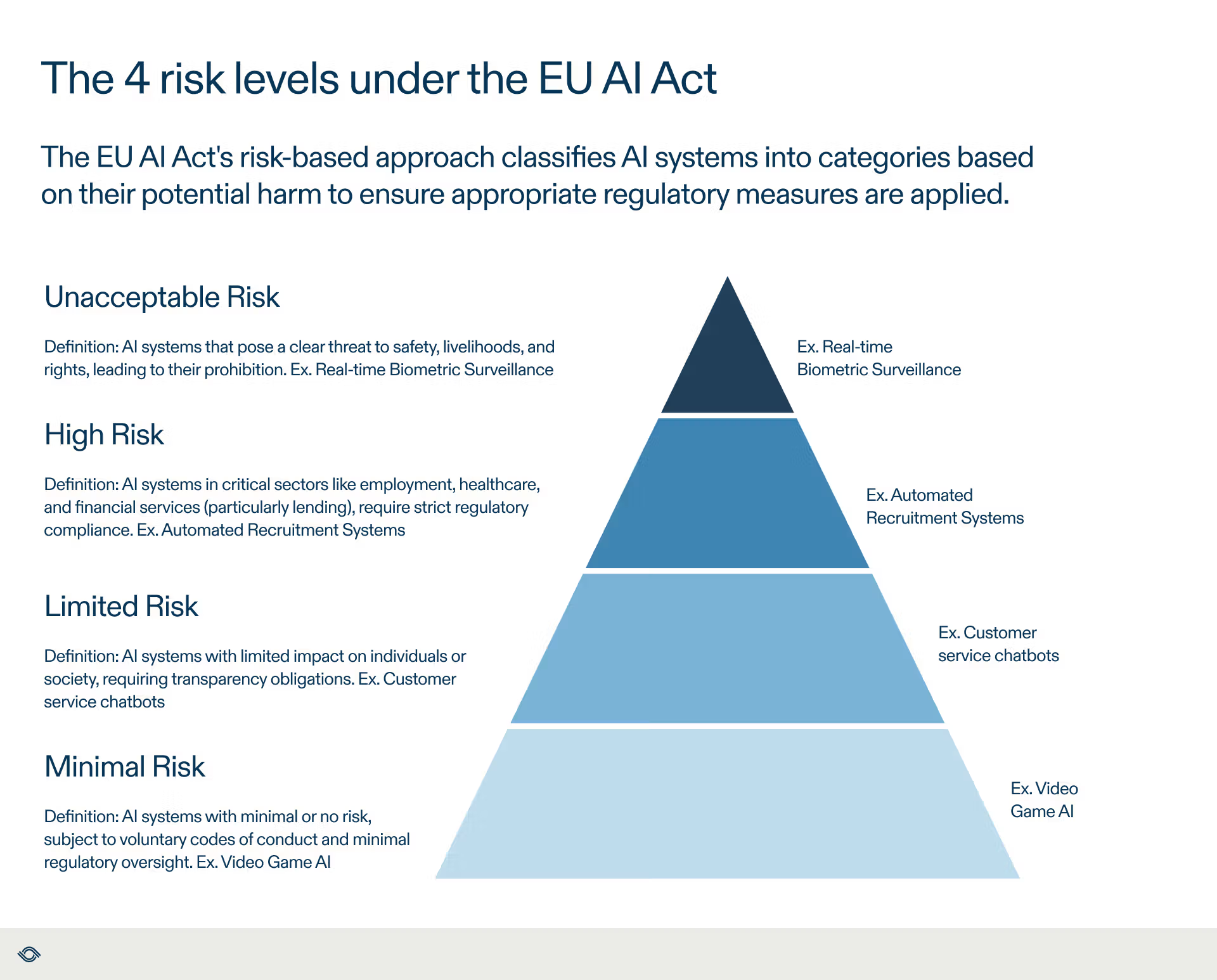
Source: Optro
These systems face requirements concerning risk management, data governance, documentation, transparency, and human oversight. Under the amended implementation timetable, the rules for high-risk employment AI systems in Annex III are scheduled to apply from December 2, 2027, although other AI Act provisions are already applicable.
In the United States, New York City's Local Law 144 regulates covered automated employment decision tools.
Employers and employment agencies using these tools need to ensure that:
- An independent bias audit has been completed within the preceding year.
- A summary of the audit results is publicly available.
- Required notices are provided to candidates or employees before the tool is used.
Make sure to check the regulations in the market you’re mapping and searching in to avoid non-compliance issues later on.
Again, this is where professional executive search firms can come in handy because they understand the regulations well and have processes for compliance.
Candidate Privacy and Data Protection
Executive recruitment involves sensitive information, including compensation expectations, career histories, interview responses, assessment results, and confidential references.
Processing this information through AI platforms can create additional privacy and security risks, particularly when third-party vendors are involved.
Under applicable data protection legislation, including the EU GDPR and UK GDPR, recruiters should consider lawful processing, transparency, data minimization, retention, and safeguards for automated decision-making.
That means search firms should know whether AI vendors retain candidate information, use it to train models, or share it with other parties. In fact, tool selection should be based on how data privacy is maintained.
Best Practices for Integrating AI into Executive Search
AI’s use in recruitment, including executive search, has its pros and cons, and it’s important to follow the best practices to ensure your organization is reaping only the benefits.
- Prioritize AI to accelerate and improve time-consuming processes: Start with candidate sourcing, market mapping, research, and administrative processes where AI can reduce manual work before incorporating it in decision-making processes.
- Verify AI-generated information: Always have an expert check candidate credentials, career histories, assessments, and research findings against reliable sources before making recommendations.
- Keep consultants involved, especially in later stages of the search: Ensure experienced professionals interpret assessment evidence, conduct interviews, manage candidate relationships, and make informed recommendations.
- Evaluate AI tools regularly: Monitor accuracy, bias, and performance. Review vendor documentation and test whether tools work reliably for the particular leadership positions being recruited.
- Measure business outcomes: Track research time, candidate pool quality, search completion rates, and hiring outcomes to determine whether AI is delivering meaningful improvements.
The Future of Executive Search Is Human-Led and AI-Assisted
AI is definitely changing executive search, mostly for the better, but what it can’t do is replace executive recruitment specialists entirely. They still add value through contextual understanding, objective assessment, and strategic thinking.
Experienced search consultants will still be needed to understand organizational priorities, assess leadership character, and build relationships with candidates.
But you can expect executive placements to move faster than before. What used to take months in the pre-AI era can now be completed in a matter of weeks.