
How AI Agents Can Improve Email Marketing, Deliverability, and Domain Security
August 13, 2026 · 6 min read
In order email campaigns to be effective, email marketers need to understand their target audience’s preferences. This involves a routine analysis of email campaign metrics, email list management and segmentation, creating of personalized campaigns, A/B testing, sending of automated sequences based on the recipient’s behavior, regular email deliverability testing, and email domain’s health monitoring.
While human participation cannot be underestimated, a lot of tasks in email marketing can be delegated to AI agents saving organizations time and human resources. AI can improve email marketing by making campaigns more personalized, relevant, data-driven, and efficient.
Moreover, email domain security specifically is one of the strongest areas where AI assistants can help, because administrators receive huge numbers of authentication events that are difficult to analyze manually.
Optimizing Your Email Marketing with AI Agents
The benefit of using AI agents in email marketing isn’t simply in writing an email fast. It’s in the ability to analyze a large amount of data to help marketers create the right message for the right audience and send it at the right time.
Here are the main ways AI agents can help:
1. Personalization at Scale
An AI agent can analyze customer behavior, purchase history, and engagement with previous messages to create more relevant emails for different segments.
For example, instead of sending the same promotion to everyone, an AI tool can recommend:
- Products based on previous purchases
- Content based on browsing behavior
- Offers based on customer interests
- Different messages for new vs. existing customers
2. Optimization of the Subject Lines and Email Copy
Depending on the email type (welcome, promotional, educational, newsletter, etc.), AI can generate and optimize the Subject line, pre-header, body, and CTA.
It can also adjust the writing style making the email copy better resonate with the target audience, and suggest alternatives designed to improve engagement.
3. Finding of the Best Sending Time
AI agents can analyze when individual subscribers are most likely to open and interact with emails. Thus, instead of sending a campaign to everyone at 4pm on Wednesday, AI can determine that:
- Subscriber A is most active in the morning
- Subscriber B usually opens emails in the evening
- Subscriber C responds better on weekends
This can improve engagement without necessarily increasing email volume.
4. Predictive List Segmentation
A traditional email list segmentation often relies on the subscriber’s data collected during registration (age, location, interests) or subscriber’s lifecycle (opens, clicks, or purchase history). An AI tool can identify behavioral patterns and predict which subscribers are:
- Likely to purchase
- Likely to unsubscribe
- Interested in a particular product
- Ready for an upsell or cross-sell
This allows senders to better target customers based on predicted behavior, not just past behavior.
5. Optimization of Automated Email Sequences
AI can help determine which message should be sent next based on how a subscriber interacts with previous emails. If a subscriber clicks a particular product, an AI agent can adapt the following emails accordingly.
Additionally, AI can identify subscribers whose activity is declining. For example, someone who normally opens 70% of emails but has stopped opening them may be classified as being at risk of churning. The email system can then automatically trigger a re-engagement campaign.
6. A/B Testing
With AI, senders can go beyond manually testing two subject lines. An AI agent can help test multiple combinations of subject lines, CTAs, images, offers, designs, or send times. Some AI-powered systems can then automatically favor the best performing variation.
7. Email Deliverability Monitoring
AI tools can also support email deliverability by analyzing email testing reports, identifying email placement trends across different providers, and suggesting the resolution steps.
There are many email tools out there that help senders in testing email deliverability and monitoring sender reputation. This helps catch deliverability issues early before they affect the efficiency of email marketing campaigns.
AI agents can be integrated with testing tools like GlockApps to access the test data, analyze the results for different domains, senders, and across different inbox providers in order to come up with a comprehensive report showcasing the problem domains, emails, and providers, and providing the remediation steps.
Identifying Email Security Breaches Fast with AI Agents
No matter how good an email copy is, all efforts are useless if the message goes to Spam or gets blocked due to a poor domain reputation or missing authentication.
Sender impersonation and domain spoofing are the major problems every business can face today. Spam and phishing emails sent by cyber criminals on behalf of a financial organization, an authority, or a reputable company can lead to huge reputational and financial losses for both the legitimate company and its clients. Therefore, the question of domain security is vital for any business regardless of its size.
To help domain owners monitor their domains’ health and activity and protect their domains against spoofing attacks, the DMARC email authentication protocol was introduced.
The Importance of DMARC for Domain Security
DMARC (Domain-based Message Authentication, Reporting, and Conformance) is the third level of email authentication ensuring the best accuracy in determining the message authenticity. If an email passes an authentication test by DMARC, it is considered authentic and legitimate – hence, it has a higher Inbox placement potential.
The DMARC protocol supports three policies (none, quarantine, and reject) that allow domain owners to give instructions to email receivers on how to handle email messages failing DMARC authentication. Thus, email senders can have spoofed messages sent directly to the recipients’ junk folders or blocked outright.
On the other hand, DMARC allows users to receive the reports about all emails sent from a given domain during the last 24 hours including the source IP addresses, SPF and DKIM outcomes. This provides a good opportunity for domain owners to monitor if their legitimate messages are properly authenticated, and detect bad actors.
DMARC Report Processing is Made Easy with Automated Tools
DMARC reports contain a lot of valuable information domain administrators can utilize in order to better secure their domains. However, as DMARC reports come as XML files grouped by the monitored domain and source IP address, the administrator can receive dozens of reports every day.
To make DMARC report processing easy, automated tools like DMARKOFF were developed. This email authentication service converts hundreds of reports into comprehensive analytics providing administrators with important information about their domain’s health and activity.
Automated DMARC monitoring tools group the data by the source IP and present email authentication and alignment outcomes, email volume, Return-Path domains, DKIM domains, and selectors.
This way, domain administrators and email deliverability consultants can easily spot authentication failures for legitimate email sources. Automatically determined unknown sources indicate if a domain was misused and how serious the attack was.
How AI Agents Help with DMARC Data Analysis
Although automated report processing tools do a great job, they often leave questions unanswered. Do I need to fix those SPF failures? Why did DKIM fail? Can I change the policy safely? This is where AI agents can help.
Modern DMARC report monitoring tools utilize AI technology allowing users to quickly re-process received analytics and get actionable insights on detected problems.
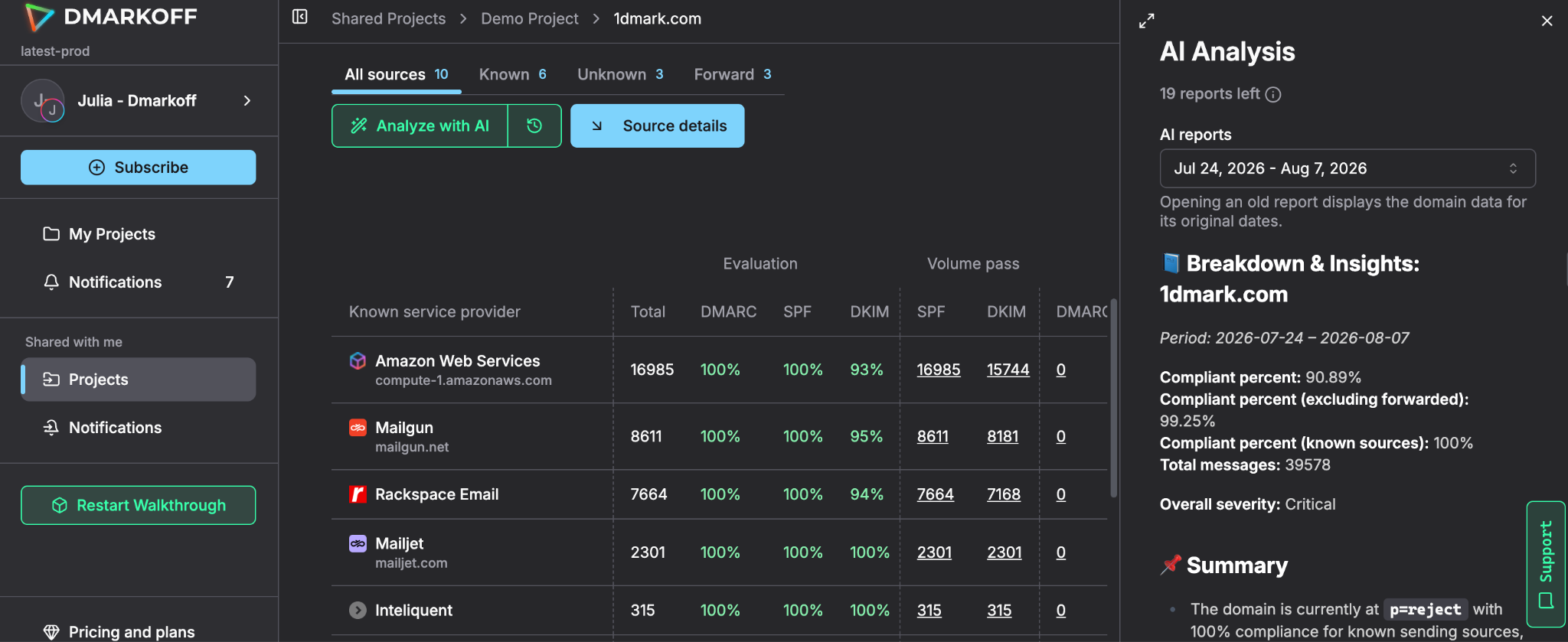
Here are the cases where AI agents can help:
1. Detecting Email Domain Spoofing and Impersonation
An AI agent can process large volumes of DMARC aggregate reports, analyze sending sources, volume, and authentication results in order to identify patterns and messages pretending to come from your domain. An AI tool can summarize the important anomalies based on:
-
- SPF failures
- DKIM failures
- DMARC alignment failures
- Unknown sending IPs
- Changes in an email volume
2. Identifying Changes in DNS Records
AI-assisted monitoring can alert administrators when important email security configurations change, including:
-
- SPF records
- DKIM keys
- DMARC policies
- MX records
3. Detecting Authentication Failures for Legitimate Senders
AI tools can analyze Return-Path domains, DKIM domains and selectors, SPF and DKIM alignment to identify email authentication issues associated with legitimate email sources, and provide administrators with precise steps on how to fix the problems.
4. Suggesting a DMARC Policy to Apply
Based on the analysis of DMARC data collected for legitimate email sources, an AI agent can suggest the best DMARC policy to use without risking to affect legal emails.
5. Predicting Security Risks
AI assistants can analyze historical patterns and estimate which domains or sending sources are most vulnerable to compromisation in the future.
Conclusion
AI agents don’t replace proper email authentication and deliverability practices. A proper list hygiene, recipient’s consent, good sending practices, deliverability monitoring, and accurate DNS configuration are still essential.
AI agents just save organizations and administrators a lot of time for processing a massive volume of data that various tools generate and allow them to make data-driven decisions in order they can send their email campaigns and secure their domains more effectively.
About the author: Julia Gulevich is Head of Customer Success at GlockApps and DMARKOFF, an email deliverability expert with 16+ years in email marketing and the author of numerous articles on email deliverability and email authentication. She is known for her practical, data-driven approach that helps teams get more emails into inboxes and keep sending practices healthy. Julia works closely with senders every day, providing technical support, troubleshooting deliverability issues, and making complex topics such as email infrastructure, authentication, and sender reputation easier to understand. Connect with Julia on LinkedIn.