
Bringing Everyday Objects Into the Digital World With AI 3D
September 23, 2026 · 8 min read
The physical world is full of objects worth remembering.
A favorite piece of furniture, an old ornament, a handmade object, a collectible, or even an interesting item found while traveling can carry visual information that is difficult to communicate through a single photograph. A picture can capture its appearance, but it cannot fully recreate the experience of looking at the object from different directions.
For years, creating a digital 3D representation of a real-world object has generally involved specialized scanning equipment, photogrammetry workflows, or manual modeling. These methods can be useful, but they are not always practical for casual creators who simply want to experiment with an object they already have.
AI-powered 3D generation offers another possibility.
Instead of thinking about 3D models only as things created from scratch, creators can begin with something that already exists in the physical world. A photograph can become the starting point for exploring a digital version of that object.
This creates an interesting connection between physical experiences and digital creativity.
The Physical World Is Full of Potential 3D References
Most people already take photographs of objects without thinking of them as potential 3D assets.
Someone might photograph a decorative item at home. A collector might take pictures of an interesting object. A traveler might capture details of an artifact or piece of architecture. A designer might photograph an object simply because its shape is inspiring.
Traditionally, these images would remain photographs.
AI 3D generation introduces another possibility: using the visual information contained in those images as a starting point for a photo to 3D model workflow.
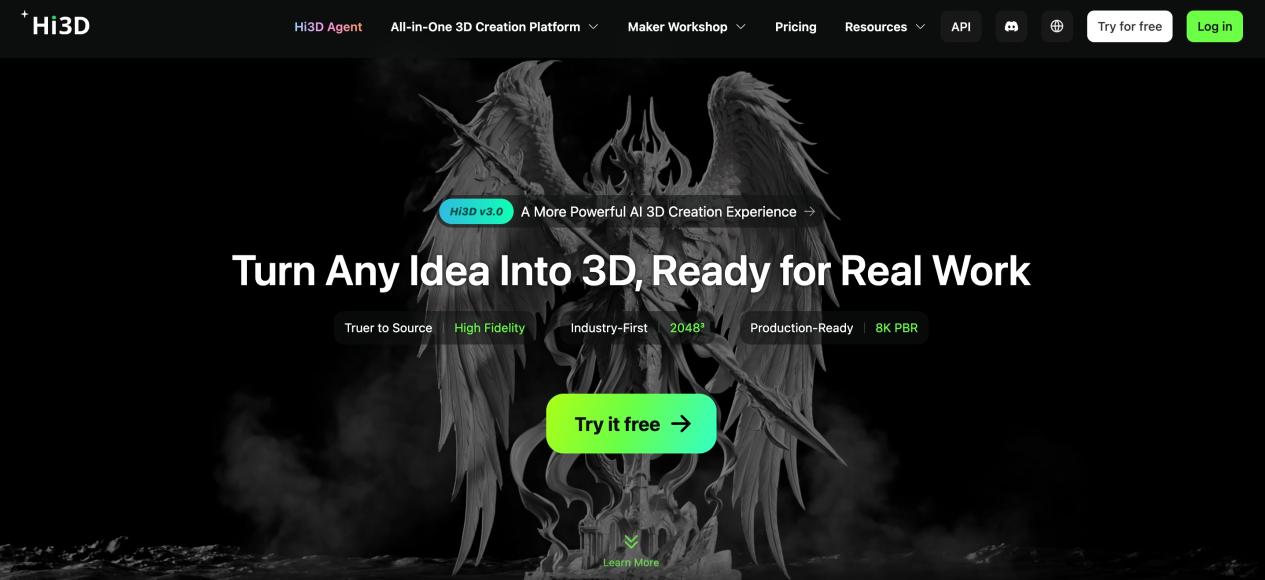
Hi3D's image-to-3D workflow allows users to upload images and generate 3D models from them. It supports common image formats such as JPG, PNG, and WEBP, while also allowing multiple views to be provided when additional visual information is available.
The concept is simple: instead of treating every photograph as the final destination, creators can also treat it as raw material for further digital exploration.
From One Photograph to a Digital Object
A photograph contains more information than just color.
It provides clues about silhouette, proportions, surface appearance, and the relationship between different parts of an object. An AI model can use these visual cues to construct a three-dimensional interpretation.
Of course, a generated model should not automatically be considered an exact digital replica of the physical object. A single photograph cannot reveal every hidden surface, and AI has to infer information that is not directly visible.
That limitation is important.
The value of image-to-3D generation is therefore not necessarily about replacing professional scanning in situations where measurement-level accuracy is essential. Instead, it can provide a convenient way to create an approximate digital representation for visualization, experimentation, and creative projects.
For many casual use cases, getting a useful starting model can be more valuable than spending hours building one manually.
Why Multiple Views Matter
The relationship between photography and 3D becomes even more interesting when more than one image is available.
A front-facing photograph shows one side of an object. A side photograph reveals information that the first image cannot. A rear view can provide additional clues about the object's overall structure.
Hi3D supports multi-view inputs, allowing users to provide two to four images, with a front view required and additional views recommended from other directions.
This gives the generation process more visual information to work with.
For someone trying to digitally recreate an object, taking a few additional photographs can therefore become part of the creative process.
Instead of asking an AI model to infer an entire object from one limited perspective, the creator can provide several perspectives and see how the resulting model changes.
Creating Digital Memories From Personal Objects
One potential use of this technology is personal documentation.
People often keep physical objects because they have sentimental or personal value. But physical objects can be difficult to share remotely.
A photograph can communicate what something looks like, while a 3D representation can provide a more interactive way to explore its form.
Imagine a small handmade decoration that has been kept for years. Instead of having only a few photographs of it, the owner could create a digital 3D version and preserve it as part of a personal digital collection.
The model could then be viewed, stored, edited, or incorporated into another digital project.
It does not have to replace the physical object.
Instead, the digital version becomes another way of remembering and interacting with it.
Collectors Can Look at Their Collections Differently
Collectors are another group that may find this approach interesting.
A physical collection is usually limited by location. The objects sit on shelves, inside cabinets, or in storage.
Digitizing some of these objects can make the collection easier to organize and share visually.
A creator could photograph individual pieces and generate corresponding 3D assets. These models could potentially be used in digital presentations, personal archives, creative scenes, or online experiences.
There is also a creative benefit.
Once an object exists as a digital asset, it can be placed into contexts that would be impossible or impractical in the physical world.
Several objects can be arranged together digitally. Their appearance can be explored from different viewpoints. A creator can experiment with different environments without physically moving the original collection.
The object has effectively gained a second life in digital space.
Turning Real-World Inspiration Into New Designs
Digitalizing an object does not have to mean copying it.
Sometimes the physical object is simply the starting point for a new idea.
A designer might photograph an interesting mechanical component because of its shape. An artist might capture an unusual ornament. A hobbyist might find an object whose proportions inspire a completely different creation.
Once a three-dimensional interpretation exists, the creator can use it as a reference for further experimentation.
The original object provides inspiration, while the digital model provides flexibility.
This is one reason AI 3D generation can be useful even when the final goal is not to reproduce the original object exactly.
The model becomes a bridge between observation and creation.
Preserving Shape While Exploring Surface Appearance
Physical objects are not defined only by their geometry.
Their visual identity can also come from materials, colors, patterns, and surface details.
This becomes particularly relevant when an object has an unusual appearance.
Hi3D provides texture generation capabilities that can be used to develop the surface appearance of generated models, including realistic and stylized approaches.
This allows creators to explore different interpretations of the same underlying form.
A physical object photographed in the real world might have a worn surface. A digital version could preserve that general visual character, or the creator could experiment with a more stylized treatment.
The important distinction is that geometry and appearance do not have to be treated as exactly the same thing.
A digital model can become a flexible creative asset rather than a static copy.
Creating a Digital Reference Library
Another possibility is building a personal library of objects.
For designers, artists, students, and hobbyists, reference libraries can be valuable sources of inspiration.
Instead of storing only photographs, creators could gradually build collections of 3D assets based on objects they encounter.
A collection might include architectural details, household objects, decorative elements, natural forms, tools, toys, or other visually interesting subjects.
Over time, the library could become a source of reusable references.
When working on a new project, the creator would not necessarily need to search for inspiration from scratch. Existing digital objects could be examined, combined, or used as starting points for new concepts.
This changes the role of AI 3D from a one-time generation tool into part of a longer-term creative archive.
Giving Old Objects New Digital Contexts
One advantage of digital objects is that they are not restricted by their original environment.
A physical object might normally sit on a shelf.
Its digital counterpart could appear inside a virtual room, an animation, a game-inspired scene, a presentation, or a conceptual design.
This does not mean every generated model will automatically be production-ready for every application. Different projects have different requirements for topology, accuracy, polygon count, textures, and optimization.
But having a usable 3D starting point can make experimentation much easier.
Hi3D supports exports including OBJ, GLB, STL, FBX, USDZ, and 3MF, so generated models can be moved into different workflows depending on what the creator wants to do with them.
The ability to export the asset is important because the generation stage is only one part of the digital creative process.
What Happens When the Object Is Too Large?
Physical size can also be separated from digital size.
A large real-world object can be represented digitally without needing to occupy physical space. This makes 3D representations useful for visual exploration even when the original object would be difficult to handle or transport.
The opposite situation is interesting too.
A creator may generate a digital model from a physical reference and later decide to produce a smaller physical version. At that point, the digital model becomes a starting point for a completely different process.
Hi3D's Split-to-Print functionality can divide models into printable sections and add connectors for assembly.
This means a digital representation does not necessarily have to remain digital. It can move between different forms depending on the creator's goal.
AI 3D Is Also About Seeing Objects Differently
The most interesting change may not be technical.
It may be conceptual.
When people look at an everyday object, they usually think about what the object is used for. A chair is something to sit on. A cup holds a drink. A decorative object sits on a shelf.
A 3D workflow encourages another question:
What information about this object could become useful in digital form?
Its shape could inspire a new design.
Its surface could become a texture reference.
Its structure could be studied from different angles.
Its proportions could become the basis of another object.
Its digital representation could become part of a virtual scene.
The physical object has not changed. What has changed is the range of things a creator can do with its visual information.
Understanding the Limits of AI Reconstruction
It is also important to keep expectations realistic when using a 3d model AI generator.
AI-generated 3D models are interpretations, not guaranteed measurements of the physical objects used as references.
Hidden surfaces may be inferred incorrectly. Fine structural details may not be reproduced perfectly. Objects with complicated geometry, transparent materials, reflective surfaces, or ambiguous shapes can present additional challenges.
For applications that require precise dimensional accuracy, professional 3D scanning, CAD modeling, or other specialized methods may still be more appropriate.
But not every project requires that level of precision.
For concept development, visual references, digital collections, experimentation, and creative exploration, an AI-generated model can provide a practical starting point.
The key is matching the tool to the purpose.
A New Relationship Between Photos and 3D
Photography and 3D modeling have traditionally been treated as separate creative activities.
A photograph captures an object from a particular viewpoint.
A 3D model represents an object as a spatial asset.
AI is beginning to blur the boundary between them.
A photo can become the first step toward a model. Multiple photos can provide additional information. The generated model can then be textured, exported, modified, or incorporated into another project.
This creates a more flexible relationship between the physical and digital worlds.
Creators do not necessarily have to decide whether something should exist as a photograph or a 3D model.
Sometimes it can exist as both.
The Physical-Digital Connection Is Just Beginning
The future of AI 3D generation is not only about producing imaginary objects.
Some of its most practical possibilities may come from the things that already surround us.
Everyday objects, personal collections, visual references, and physical designs can all become starting points for digital experimentation.
Hi3D provides one way to explore this connection through image-to-3D generation and additional tools for textures, model preparation, and different forms of export.
For creators, the larger opportunity is to rethink the role of the objects they encounter every day.
A photograph does not necessarily have to remain a photograph.
A physical object does not necessarily have to stay in one physical location.
And a familiar object can become the starting point for something entirely new once it enters the digital world.