
6 Best Proxies for AI Web Scraping in 2026
September 29, 2026 · 13 min read
AI web scraping helps teams collect fresh public data for model training, RAG systems, market analysis, and agent workflows. These projects often need to process large volumes of pages across multiple locations while maintaining consistent access to dynamic websites and controlling how requests are distributed.
According to Stanford HAI’s 2026 AI Index Report, 88% of surveyed organizations used AI in 2025, while 70% used generative AI in at least one business function. As AI systems increasingly depend on current external information, proxy infrastructure becomes an important layer for collecting approved public data with the location coverage, session control, and parallel capacity required by AI models, agents, and LLM workflows.
Why Do AI Web Scraping Workflows Need Proxies?
AI web scraping workflows can generate recurring requests across large numbers of pages, locations, and data sources. Proxies help teams distribute approved collection traffic, access location-specific public data, and support scalable scraping infrastructure without routing every request through the same connection.
Request Distribution
Proxies spread collection traffic across available IP addresses instead of sending every request through one company connection. This gives scraping systems more flexibility when working across multiple pages, domains, or scheduled collection jobs.
Rate-Limit Management
Repeated requests from a single IP can create unnecessary concentration of traffic and interrupt scheduled collection workflows. Proxy rotation allows teams to distribute requests more evenly while configuring collection rates around the requirements of each public source.
Geo-Specific Data Collection
Some public content varies by country, city, or network context. Proxies allow AI scraping systems to collect localized search results, pricing, listings, availability, and other location-dependent information from the geographic context required by the dataset.
Large-Scale and Parallel Scraping
AI data pipelines may run multiple crawlers, agents, or workers at the same time and refresh large datasets on recurring schedules. Proxy infrastructure helps distribute these parallel requests across multiple IPs and locations instead of relying on a single connection.
RAG Pipelines and AI Agents
RAG systems and AI agents often need recurring access to public sources to refresh retrieval indexes, verify information, or complete multi-step browsing tasks. Proxies provide the connection and session controls needed to support these repeated collection workflows across different sources.
What Makes a Good Proxy for AI Web Scraping?
A good proxy for AI web scraping provides reliable access to approved public sources, accurate location controls, session settings that match the collection flow, and enough capacity for the expected request volume. The right setup depends on the target website, dataset requirements, and how the AI pipeline handles extraction and refreshes.
- IP quality: Use well-maintained IPs that fit the sensitivity and location context of the public target.
- Geo-targeting: Confirm that the required countries, cities, states, ISPs, or ASNs are available on the selected product.
- Rotation control: Match IP rotation frequency to broad discovery, high-volume extraction, or other collection tasks.
- Sticky sessions: Keep one identity for pagination, browser-based extraction, and multi-step website flows.
- Concurrency: Make sure the plan supports the number of parallel crawlers, agents, and scheduled jobs.
- Protocol support: Confirm HTTP, HTTPS, and SOCKS5 compatibility with the scraper, browser, API client, or automation framework.
- Cost at scale: Compare traffic pricing, retries, location requirements, and projected dataset growth rather than only the entry rate.
How Does a Proxy vs. VPN Compare for AI Web Scraping?
When comparing a proxy vs. VPN for AI web scraping, the main difference is the level of control over traffic, IPs, locations, and individual sessions. A VPN typically routes a device or network connection through another server, while proxy services provide more granular routing and session management for automated collection workflows.
Traffic and Session Control
Proxies can route traffic separately for individual scrapers, browser profiles, applications, or workers. They can also support sticky sessions and multiple concurrent connections, allowing separate collection tasks to maintain their own connection settings. VPNs typically operate at the device or network level and provide less granular control over individual scraping sessions.
IP Rotation
Proxy services can rotate IPs automatically between requests or according to configured session rules. VPN connections generally use one exit IP until the user changes the server or reconnects, which provides less flexibility for recurring collection tasks.
Geo-Targeting
Proxy networks may provide country, city, state, ISP, or ASN targeting depending on the provider and proxy type. VPNs usually allow users to choose from predefined server locations rather than configure location parameters for individual scraping requests.
Automation and Scale
Proxies are generally better suited to automated collection systems that process many public pages, locations, or data sources in parallel. A VPN may be sufficient for manual research or a single consistent exit location, but it typically provides fewer controls for large-scale request distribution and automated session management.
What Are the 6 Best Proxies for AI Web Scraping in 2026?
The providers below offer different combinations of residential, mobile, ISP, and datacenter access for AI data collection. The best option depends on target sensitivity, session length, location requirements, and the scale of the scraping pipeline.
| Provider | Proxy Types | Geo-Targeting | Session Control | Concurrency / Scale | Best for AI Scraping |
|---|---|---|---|---|---|
| 1. Live Proxies | Rotating residential, rotating mobile | Country, city, ASN | Rotation per request, sticky up to 24 hours | Unlimited threads | Persistent, location-specific AI collection |
| 2. Oxylabs | Residential, ISP, datacenter, mobile, dedicated ISP | Country, city, state, ZIP code, ASN | Rotating, sticky sessions up to 10 minutes | Enterprise infrastructure | Large production data pipelines |
| 3. Decodo | Residential, ISP, datacenter, mobile | Country, state, city, ZIP code, ASN | Rotating, sticky sessions up to 24 hours | Scalable traffic plans | Flexible AI scraping and automation |
| 4. SOAX | Residential, mobile | Country, region, city, ISP, ASN | Rotating, sticky sessions up to 60 minutes | Business-scale access | Geo-sensitive and mobile-web data |
| 5. Webshare | Rotating residential, static residential, private static residential, dedicated static residential | Country, state, city, ZIP code, ASN | Rotating, sticky sessions up to 60 minutes | Self-service scaling | Developer-managed collection |
| 6. IPRoyal | Residential, ISP, datacenter, mobile | Country, state, city | Rotating, sticky sessions up to 7 days | Unlimited simultaneous sessions | Recurring and persistent collection |
1. Live Proxies
Live Proxies is a strong option for AI teams evaluating an unblocked proxy solution for persistent, location-specific collection workflows. Its private rotating residential and mobile access, private IP allocation, reduced overlap between users, quality filtering, millions of IPs across 55 countries, unlimited threads, and sticky sessions of up to 24 hours give teams greater control over high-volume AI data collection. For sensitive public targets, these controls can reduce the risk of inheriting reputation issues from shared traffic, although no provider can guarantee access to a specific website.
For teams comparing unlimited bandwidth proxies, the key question is whether fixed unmetered traffic or a usage-based model better suits the expected collection volume. Live Proxies is particularly relevant when detailed targeting, private allocation, and parallel capacity matter more than a one-size-fits-all traffic model.
AI Scraping Strengths
- Private IP allocation: Exclusive B2C allocation and reduced overlap for B2B workflows help teams keep collection environments more controlled.
- Millions of IPs: Supports flexible rotation across 55 countries, with particularly strong coverage in the US, Canada, and the UK.
- Geo-targeting: Country, city, and ASN controls help align public data collection with the required market context.
- Rotation / Sticky: IPs can rotate per request or remain sticky for up to 24 hours for connected browser and extraction flows.
- Unlimited threads: Supports parallel AI agents, crawlers, and scheduled collection workers without restrictive thread limits.
- Protocol support: HTTP and SOCKS5 compatibility fits common scrapers, browser tools, API clients, and automation frameworks.
Best Fit
- Large-scale AI web scraping: Run parallel collection workers across public source categories and locations.
- LLM data collection: Build and refresh approved source sets for research, retrieval, and evaluation.
- RAG pipelines: Maintain stable sessions for multi-page extraction and recurring knowledge-base updates.
- AI agents: Support multi-step browser workflows that need a consistent identity for a defined period.
- Geo-specific datasets: Collect public outputs from country, city, or ASN-specific contexts.
Pricing
- Standard: Rotating residential plans start at $70 for 4GB over 30 days.
- Enterprise: High-volume plans start from $2,000 per month for 1TB, equivalent to $2 per GB. B2B trials are available.
2. Oxylabs
Oxylabs is an enterprise-focused provider that combines a broad proxy portfolio with managed web-data collection products. Its residential, mobile, ISP, datacenter, and dedicated ISP options can support AI teams that collect data from different source types, regions, and technical environments within the same pipeline.
The platform is particularly relevant for established organizations that need structured account support, detailed geo-targeting, and infrastructure that can scale across multiple production workers. Managed scraping products can also reduce the amount of proxy routing, rendering, and extraction infrastructure that an internal team needs to maintain directly.
AI Scraping Strengths
- Enterprise infrastructure: Supports sustained collection workloads across multiple regions and public source types.
- Proxy range: Offers residential, mobile, ISP, datacenter, and dedicated ISP products for different collection stages.
- Detailed targeting: Provides geo-specific controls that can include country, city, state, ZIP code, and ASN options.
- Rotation / Sticky: Supports rotating configurations and sticky sessions of up to 10 minutes for shorter connected flows.
- Managed data tools: Includes web-scraping products that can complement raw proxy access when teams want less infrastructure to operate directly.
Best Fit
- Enterprise AI data collection: Support recurring data acquisition for larger AI and data-engineering teams.
- Large datasets: Collect public information across many sources, locations, and categories.
- Production pipelines: Fit organizations with established governance, reporting, and reliability requirements.
- High-volume workloads: Scale collection capacity across several workers and markets.
Pricing
- Standard: Residential proxies start at $30 for 5GB ($6 per GB), while mobile proxies start at $30 for 4GB ($7.50 per GB).
- Enterprise: Residential plans start at $2,500 per month for 1TB ($2.50 per GB). Mobile enterprise plans start at $2,500 for 715GB per month.
3. Decodo
Decodo, formerly Smartproxy, provides residential, mobile, ISP, and datacenter proxies alongside web-scraping and search-data tools. This combination can suit AI teams that need to change connection types between source categories, test several collection methods, or combine direct proxy access with managed data retrieval.
Its targeting controls, rotating and sticky sessions, and scalable traffic plans make it a practical option for teams moving from prototypes to larger recurring workflows. Decodo is especially useful when a pipeline includes broad discovery, region-specific extraction, and validation tasks that may need different proxy configurations.
AI Scraping Strengths
- Multiple proxy types: Provides residential, mobile, ISP, and datacenter products for different target types and technical requirements.
- Advanced targeting: Supports continent, country, state, city, ZIP-code, and ASN targeting on relevant products.
- Rotation / Sticky: Offers rotating sessions and sticky residential sessions for up to 24 hours.
- Scraping tools: Provides proxy infrastructure alongside web-scraping and search-data products.
- Scalable access: Supports direct proxy use alongside automation tools and scalable traffic plans.
Best Fit
- Growing AI scraping projects: Expand collection capacity as datasets and source coverage increase.
- Automation: Support scripts, crawlers, and data pipelines that use configurable locations and sessions.
- Regional data collection: Gather public web information from defined countries, cities, and local markets.
- Mid-to-large workloads: Combine direct proxy access with managed collection tools when needed.
Pricing
- Standard: Residential and mobile proxy plans start at $3.75 per GB, while pay-as-you-go access costs $4 per GB.
- Enterprise: Residential plans cost $625 for 250GB per month ($2.50 per GB), while the 1TB plan costs $2,000 per month ($2 per GB). Custom plans are also available.
4. SOAX
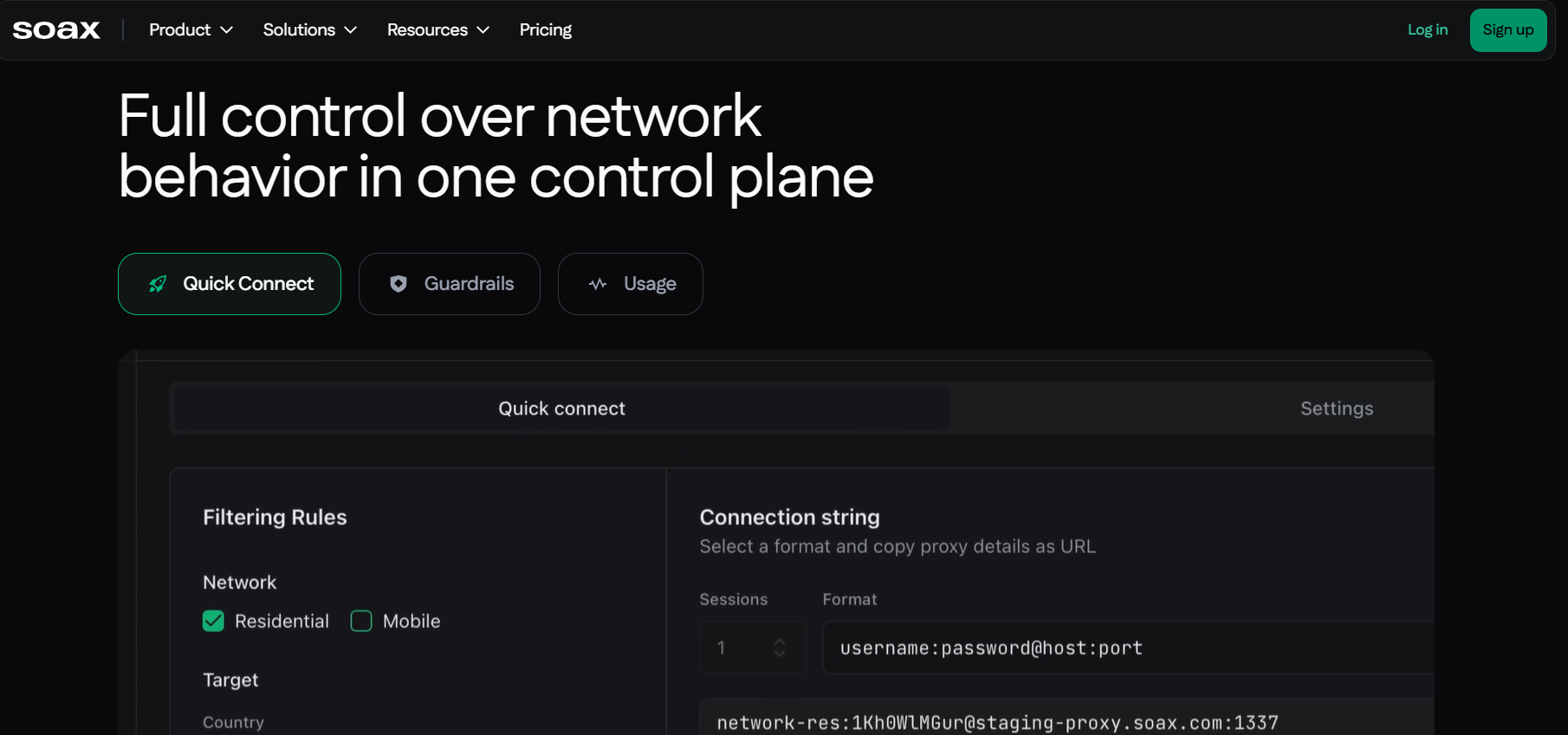
SOAX provides residential and mobile proxies for AI collection workflows where geographic and network context directly affects the output. Its targeting controls can help teams collect public data from a defined country, region, city, ISP, or ASN instead of relying on a generic national connection.
This makes SOAX relevant for localized datasets, market intelligence, mobile-web research, and projects where pricing, search results, availability, or content can vary by location. Its Web Data API also gives teams an alternative to managing every collection request through raw proxies alone.
AI Scraping Strengths
- Residential and mobile access: Provides consumer-network and carrier-network proxy options for varied public-web targets.
- Granular targeting: Supports country, region, city, ISP, and ASN controls on relevant products.
- Rotation / Sticky: Provides rotating access and sticky sessions of up to 60 minutes for connected collection tasks.
- Broad location coverage: Supports collection workflows across a wide range of locations.
- Web-data infrastructure: Offers a Web Data API for teams that need managed collection options alongside proxy access.
Best Fit
- Localized AI datasets: Collect public information that reflects a country, region, city, or network context.
- Mobile web data: Support research involving mobile-first public websites and carrier-related contexts.
- Geo-sensitive scraping: Collect public search, pricing, content, or advertising data that differs between locations.
- Market intelligence: Gather product, availability, news, and competitor data from target markets.
Pricing
- Standard: The Builder plan costs $200 per month plus VAT and includes 200 credits. Traffic rates vary by location tier.
- Enterprise: Enterprise plans start at $3,000 per month plus VAT, with lower traffic rates at larger volumes.
5. Webshare
Webshare is a self-service provider offering rotating residential, static residential, private static residential, and dedicated static residential proxies. Its dashboard and API tools can suit developer-led AI scraping projects where the team wants to control credentials, proxy lists, targeting, and integration with its own crawlers.
The platform is a practical fit for teams that prefer to build and manage their own collection stack rather than rely on a fully managed service. It can support testing, scheduled extraction, and gradual scaling when the workflow needs location controls alongside straightforward account management.
AI Scraping Strengths
- Residential options: Offers rotating residential, static residential, private static residential, and dedicated static residential products.
- Granular locations: Residential configurations support country, state, city, ZIP code, and ASN targeting.
- Rotation / Sticky: Rotating residential sessions can remain sticky for up to 60 minutes when a workflow needs short-term continuity.
- Developer access: API support and a self-service dashboard help teams automate provisioning and proxy management.
- Scalable plans: Traffic tiers allow teams to start with smaller workloads and add capacity as their pipeline grows.
Best Fit
- Developer workflows: Build and test crawlers, parsers, and AI data pipelines with self-managed controls.
- Cost-sensitive scraping: Scale traffic gradually without adopting a fully managed platform.
- Moderate automation: Support scheduled extraction jobs and repeatable public-data collection.
- AI data collection: Run location-specific collection through internal scripts and reporting systems.
Pricing
- Standard: Rotating residential plans start at $3.50 per GB for a 1GB monthly plan.
- Enterprise: Custom plans are available for enterprise customers.
6. IPRoyal
IPRoyal provides residential, ISP, mobile, and datacenter proxies with flexible traffic purchasing for different collection requirements. Its residential traffic does not expire, which can be useful for AI teams that run irregular refreshes, smaller research jobs, or recurring collection tasks that do not consume the same volume every month.
The provider can suit teams that need rotating access for broad collection and longer sticky sessions for connected browser or extraction flows. Country, state, and city targeting, together with HTTP(S) and SOCKS5 compatibility, make it relevant for localized public-data collection and moderate AI scraping workloads.
AI Scraping Strengths
- Multiple proxy networks: Offers residential, ISP, mobile, and datacenter products for different workflow requirements.
- Geo-targeting: Provides country, state, and city controls for location-specific public data collection.
- Rotation / Sticky: Supports rotating sessions and sticky residential sessions that can last up to seven days.
- Non-expiring traffic: Lets teams use purchased residential traffic when scheduled jobs require it.
- Technical compatibility: Supports HTTP(S), SOCKS5, API access, and unlimited simultaneous sessions.
Best Fit
- Smaller AI scraping projects: Test sources, locations, and extraction logic before expanding.
- Persistent sessions: Support public-web tasks that need a consistent identity across connected steps.
- Localized collection: Gather regional public data for market, search, and content research.
- Moderate recurring workloads: Run data refreshes and automated jobs with flexible traffic purchasing.
Pricing
- Standard: Residential traffic starts at $1.75 per GB. ISP proxies start at $2.40 per proxy.
- Enterprise: Rotating residential plans start at $1,500 for 1TB ($1.50 per GB), while custom 5TB+ plans start from $0.75 per GB.
Which Proxy Types Work Best for AI Web Scraping?
The best proxy type depends on target sensitivity, location requirements, session length, and the number of concurrent collection workers. AI pipelines may use more than one network type as the data source or workflow stage changes.
Residential Proxies
Residential proxies use IPs associated with consumer internet connections. They can suit public sources that need location-specific access, controlled rotation, or a consumer-network context for broad collection and protected targets.
Mobile Proxies
Mobile proxies route traffic through carrier-based IP addresses. They can be useful for mobile-first websites, carrier-sensitive content, and public data that varies by mobile network or device environment.
ISP Proxies
ISP proxies provide a more stable, ISP-issued identity than rotating residential access. They can fit persistent sessions, longer browser workflows, and account-based tasks where an IP needs to remain consistent.
Datacenter Proxies
Datacenter proxies are often fast and cost-effective for large request volumes and less sensitive public targets. They are useful for technical tasks where granular consumer-network context is not the main requirement.
How Do You Choose an AI Scraping Proxy?
The right AI scraping proxy matches the source requirements and collection design rather than the provider with the largest advertised pool. Teams should test real workloads before committing to large traffic volumes or long contracts.
- Target difficulty: Assess how sensitive each public source is to repeated automated requests and select an appropriate proxy type.
- Required locations: List the countries, cities, states, ISPs, or ASNs needed for the dataset.
- Request volume: Estimate the number of pages, refresh cycles, and concurrent workers before selecting a plan.
- Rotation frequency: Use frequent rotation for broad collection and stable sessions for connected browsing flows.
- Session length: Confirm that sticky-session limits fit pagination, JavaScript rendering, or agent tasks.
- Protocol needs: Check HTTP, HTTPS, and SOCKS5 compatibility with the existing technical stack.
- Cost per successful request: Include retries, response sizes, and location-specific traffic needs in the final comparison.
- Trial testing: Run a small approved pilot against actual public sources before scaling the pipeline.
Which AI Web Scraping Use Cases Need Proxies?
AI systems can use proxies whenever they need to gather fresh, location-aware public information from several sources or run recurring extraction without routing all activity through one organization’s network.
LLM Training
Teams may collect permitted public datasets, documents, product information, and other text sources for model training or evaluation. Proxies can help distribute collection traffic and gather information from the locations relevant to the intended dataset.
RAG
RAG pipelines rely on current source material for retrieval. Proxies can support scheduled content refreshes, source validation, and localized collection when the knowledge base needs public information from specific markets.
AI Agents
AI agents may need to navigate several pages, submit search queries, or follow multi-step public workflows. Sticky sessions can help maintain a consistent identity during these connected tasks.
Market Intelligence
Businesses use AI systems to analyze public product data, pricing, availability, reviews, and competitor activity. Geo-targeted proxies can help capture the context that customers in a selected market may see.
Search Data
Localized SERPs can support search analysis, content research, and AI-driven SEO workflows. Proxy targeting helps teams compare public search results by country, city, and other available location settings.
What Do You Test Before Scaling AI Web Scraping?
A proxy plan should be validated against the actual target websites, data volumes, locations, and automation tools used by the AI workflow. A small pilot can reveal technical or cost issues before the project expands.
- Success and error rates: Measure completed requests, timeouts, failed connections, verification challenges, and other issues across the selected public sources.
- IP reputation: Review whether available IPs work reliably for the target type and required location.
- Geo accuracy: Check that the detected country, city, or network context matches the requested setting.
- Session stability: Test whether sticky sessions remain stable for the full browser, agent, or extraction flow.
- Rotation behavior: Confirm that IP changes occur at the intended frequency and do not interrupt the workflow.
- Latency and cost: Measure response times, bandwidth use, retries, and processing overhead to understand throughput and the actual cost per successful request.
Conclusion
The best proxy for AI web scraping depends on target difficulty, location requirements, session behavior, and the scale of the collection pipeline. Providers such as MangoProxy offer the geo-targeting and session control that large-scale AI scraping pipelines need. Teams need to compare access quality, geo-targeting, concurrency, protocol compatibility, and total operating cost rather than choosing based on pool size alone.
Testing providers against real public sources, locations, and AI workflows before scaling helps create a more reliable collection process. Proxies work best as one part of a controlled data pipeline that also includes responsible request rates, extraction logic, source tracking, and data-quality checks.