

Pi Coding Agent
Overview
An open-source terminal coding agent that developers can extend with packages, skills, prompts, and custom workflows.
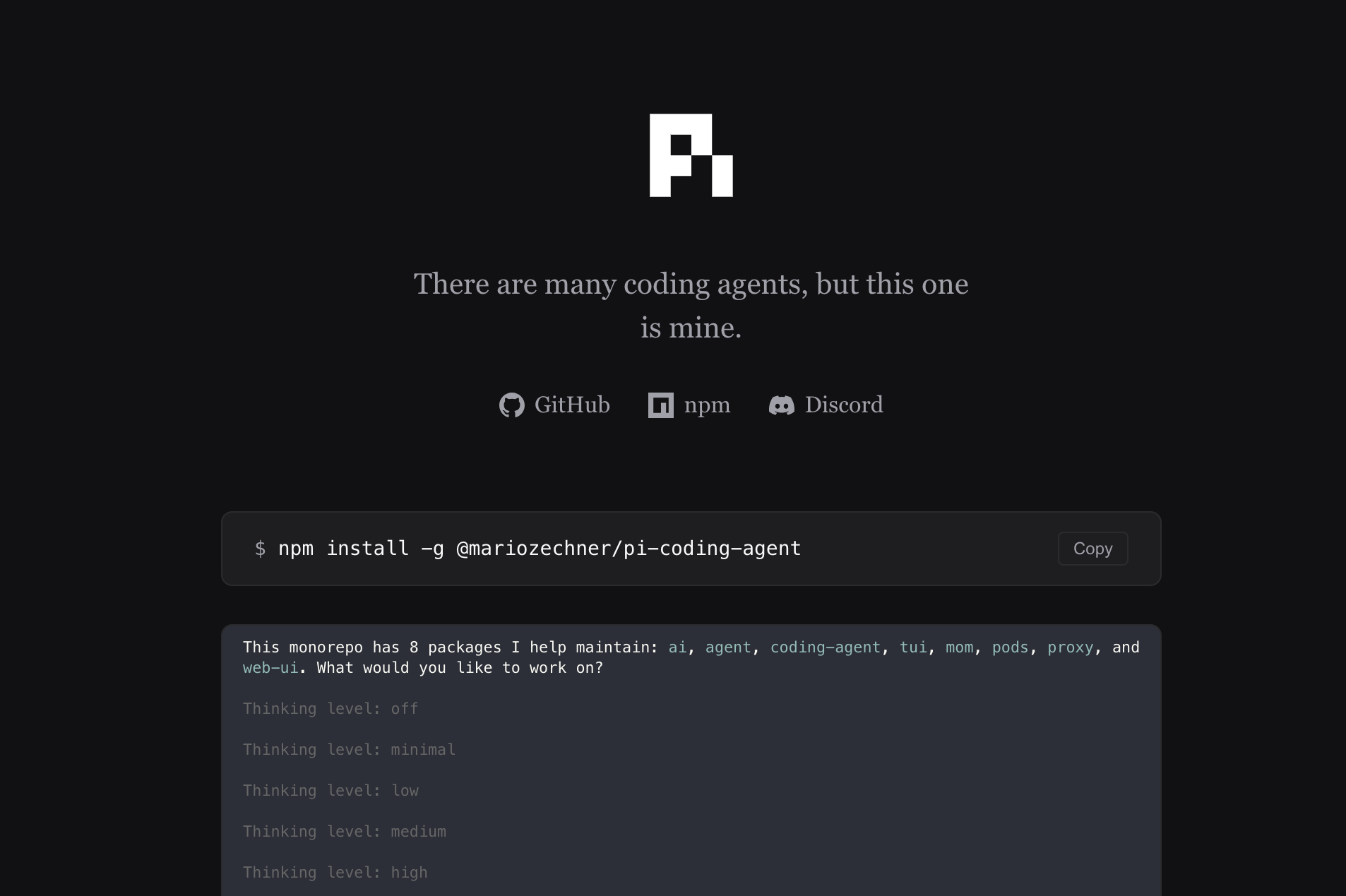
Pi Coding Agent is an open-source terminal-first coding agent designed for developers who want a lightweight but highly extensible AI coding workflow. Its official site describes it as a minimal coding harness that can be adapted through TypeScript extensions, skills, prompt templates, themes, and shareable packages installed from npm or git. The agent supports interactive terminal use, print and JSON modes, RPC, and SDK-based embedding, while also offering tree-structured session history, model switching, customizable context engineering, and integration with many model providers. Rather than enforcing one rigid workflow, Pi is built as a flexible foundation for coding agents that developers can shape to match their own engineering process.
Product overview
Capabilities, pricing and fit
Pi is an open-source terminal coding agent and extensible agent harness. Its deliberately small core provides tool use, multi-provider model access, tree-structured sessions, and interactive, print/JSON, RPC, and SDK modes, while extensions and packages supply workflow-specific behavior.
Information as of August 15, 2026
What it can do
- Extensible coding-agent harness
TypeScript extensions, skills, prompt templates, themes, and packages can add tools, commands, context, UI behavior, and workflows to the minimal core.[1], [2]
- Multi-provider model access
Pi supports more than 15 model providers and lets users switch models within a session or configure custom providers and models.[1]
- Branching and programmatic sessions
Sessions are stored as navigable trees, and Pi can run interactively, emit print or JSON streams, expose an RPC protocol, or embed through its SDK.[1]
Where it fits best
Pricing and availability
Pi is free and MIT-licensed. Users provide a supported model subscription or API key and pay any model-provider or local-compute costs separately.[1], [2], [3]
Platforms: macOS terminal, Linux terminal, Windows terminal, Node.js package, RPC, SDK[1], [2], [3]
Access: Local CLI, Containerized or sandboxed local execution, Embedded agent runtime[1], [2], [3]
What users repeatedly mention
Two independent hands-on reviewers agree that Pi's multi-provider flexibility, small core, and extensibility are its main strengths. Both also describe a substantial setup burden and emphasize that sandboxing, permissions, subagents, MCP, and other conveniences must be added rather than assumed.[4], [5]
Important considerations
- Pi has no built-in permission system for filesystem, process, network, or credential access and runs with the launching user's permissions unless it is sandboxed or containerized.[3]
- The core intentionally omits built-in MCP, subagents, plan mode, permission popups, to-do lists, and background shell management; users add equivalents through extensions or external tools.[1]
- Pi itself is free, but most hosted models require a supported subscription login or the user's own provider API key and separate provider charges.[1], [2]
Sources (5)
- Pi Coding AgentOfficial site · checked 2026-08-15
- Pi DocumentationDocumentation · checked 2026-08-15
- earendil-works/pi | GitHubGitHub · checked 2026-08-15
- Pi hands-on review and audit | PostcursorsIndependent review · checked 2026-08-15
- Pi Coding Agent - From Barebones to Better Than OpenCodeIndependent review · checked 2026-08-15
Autonomy level
79/100
Our subjective rating of how independently the product carries out its documented tasks, considering the human setup, input, approval and review it needs. This is not a measured success rate.
Comparisons
Custom Comparisons
Some of the use cases of Pi Coding Agent:
- Running an open-source terminal coding agent with customizable workflows and tools.
- Extending coding-agent behavior with TypeScript extensions, skills, prompt templates, and packages.
- Embedding a coding agent into scripts, apps, or integrations through JSON, RPC, or SDK modes.
- Managing long coding sessions with tree-structured history, branching, and customizable context handling.
Loading Community Opinions...
Pricing model:
Code access:
Popularity level: 63%
Tags:
Pi Coding Agent Video:
Turn this profile into a trust signal
Show prospects that Pi Coding Agent has a public place where they can check product details, pricing, ratings, and reviews.
Build confidence
Give buyers a third-party profile to explore.
Reduce hesitation
Put validation beside your strongest CTA.
Earn discovery
Every badge links prospects to your listing.
Choose your style
Preview it, then copy the complete embed code.
Shows buyers where to validate your product, pricing, and reputation.
Plain HTML. No signup, script, or maintenance required.
 AI Agent Store · Specialist AI agents
For in-house software product engineering teams
Your AI agent for extensible terminal coding assignments.
Exploring Pi Coding Agent? For in-house software product engineering teams, your own AI agent can investigate product issues, implement and test changes, and ship and follow releases. Start with a setup tailored to this work.
- ✓ Investigate product issues
- ✓ Implement and test changes
- ✓ Ship and follow releases
Tailored starting setup. Chat on our site. See the workflow and monthly plan.