

ORCH
Overview
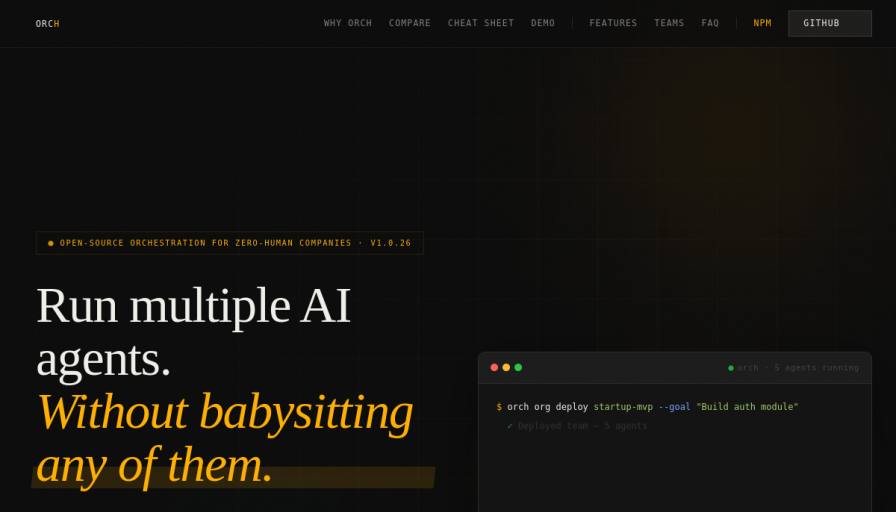
Open-source CLI orchestrator for running multiple coding agents in parallel with git isolation, retries, state tracking, and review.
ORCH is an open-source orchestration tool for coordinating multiple AI coding agents and CLI tools on one project. It can dispatch agents such as Claude, Codex, Cursor, Grok, Antigravity, OpenCode, and shell-based tools in parallel, while using git worktree isolation, task state tracking, retries, review steps, and a local terminal dashboard. It is designed for developers and teams that want local, self-hosted multi-agent workflows rather than a cloud-hosted agent platform.
AI Agent Store research
What the evidence says about ORCH
ORCH is positioned as a local, open-source orchestration layer for software teams using multiple AI coding agents. Its distinctive focus is coordinating separate agent runs through shared context, git worktree isolation, retries, task states, and review gates, so developers can run parallel agent workflows without manually moving outputs between tools.
Verified August 25, 2026
Verified capabilities
- Multi-agent orchestration
Coordinates Claude, Codex, Cursor, Grok, Antigravity, OpenCode, and shell or other CLI tools in parallel on the same project.[1]
- Git isolation for parallel work
Uses git worktree isolation so agents can work in separate branches or scopes without overwriting each other’s files, with merge-back described on the official page.[1]
- Task state tracking
Governs tasks through a formal state machine shown as todo, in_progress, review, and done.[1]
- Agent communication and context sharing
The official page says agents can message each other directly and share context through a shared store and prompt injection.[1]
- Retries and unattended execution
The orchestrator dispatches, monitors, retries with backoff, and can run unattended while users review results later.[1]
- Local terminal dashboard
Provides a real-time TUI dashboard for tasks, agents, goals, token costs, and review results in the terminal.[1]
- Headless daemon mode
Supports orch serve for daemon-style operation with structured JSON logs, graceful shutdown, and pm2/systemd readiness described on the official page.[1]
- Ready-made teams and adapters
The official page lists 10 ready-made teams and 8 AI tool adapters.[1]
Where it fits best
- Developers and engineering teams that want to coordinate several AI coding agents or CLI tools on one project in parallel.[1]
- Teams that prefer local or self-hosted execution, because the official page describes zero cloud dependencies, local state storage, and daemon mode on a server.[1]
- Workflows that need review gates before changes merge, because the official page says every change waits in review for user approval and shows a todo-to-done task state machine.[1]
Important considerations
- ORCH is presented as a CLI/TUI and daemon-based tool, so teams looking for a managed cloud dashboard are not the primary fit based on the supplied official page.[1]
- Human approval remains part of the workflow: the official page states that every change waits in review for approval.[1]
- The supplied official page does not show hosted-plan pricing, paid tiers, or enterprise pricing details.[1]
Sources and research method (1)
We record only claims tied to public sources checked by our team or listing workflow. Counts above are derived directly from this profile, not a subjective rating.
- ORCH — Run multiple AI agents on one project. Without babysitting.Official site · checked 2026-08-25
Autonomy level
76/100
Our subjective rating of how independently the product carries out its documented tasks, considering the human setup, input, approval and review it needs. This is not a measured success rate.
Comparisons
Custom Comparisons
Some of the use cases of ORCH:
- Running multiple coding agents on the same software project
- Coordinating agent tasks with review and state tracking
- Keeping parallel agent work isolated with git worktrees
- Running local or server-based headless agent orchestration
- Managing agent teams from a terminal dashboard
Loading Community Opinions...
Pricing model:
Code access:
Popularity level: 26%
Industries:
ORCH Video:
Turn this profile into a trust signal
Show prospects that ORCH has a public place where they can check product details, pricing, ratings, and reviews.
Build confidence
Give buyers a third-party profile to explore.
Reduce hesitation
Put validation beside your strongest CTA.
Earn discovery
Every badge links prospects to your listing.
Choose your style
Preview it, then copy the complete embed code.
Shows buyers where to validate your product, pricing, and reputation.
Plain HTML. No signup, script, or maintenance required.
Describe the job. Get an AI worker you can actually message.
We create the setup, keep it running after your laptop closes, and save its memory. Test in the browser, then add Telegram, WhatsApp, or Slack.
Plans start at $29/month. Cancel anytime.
Hosted agent
OpenClaw or Hermes