

Hermes Agent
Overview
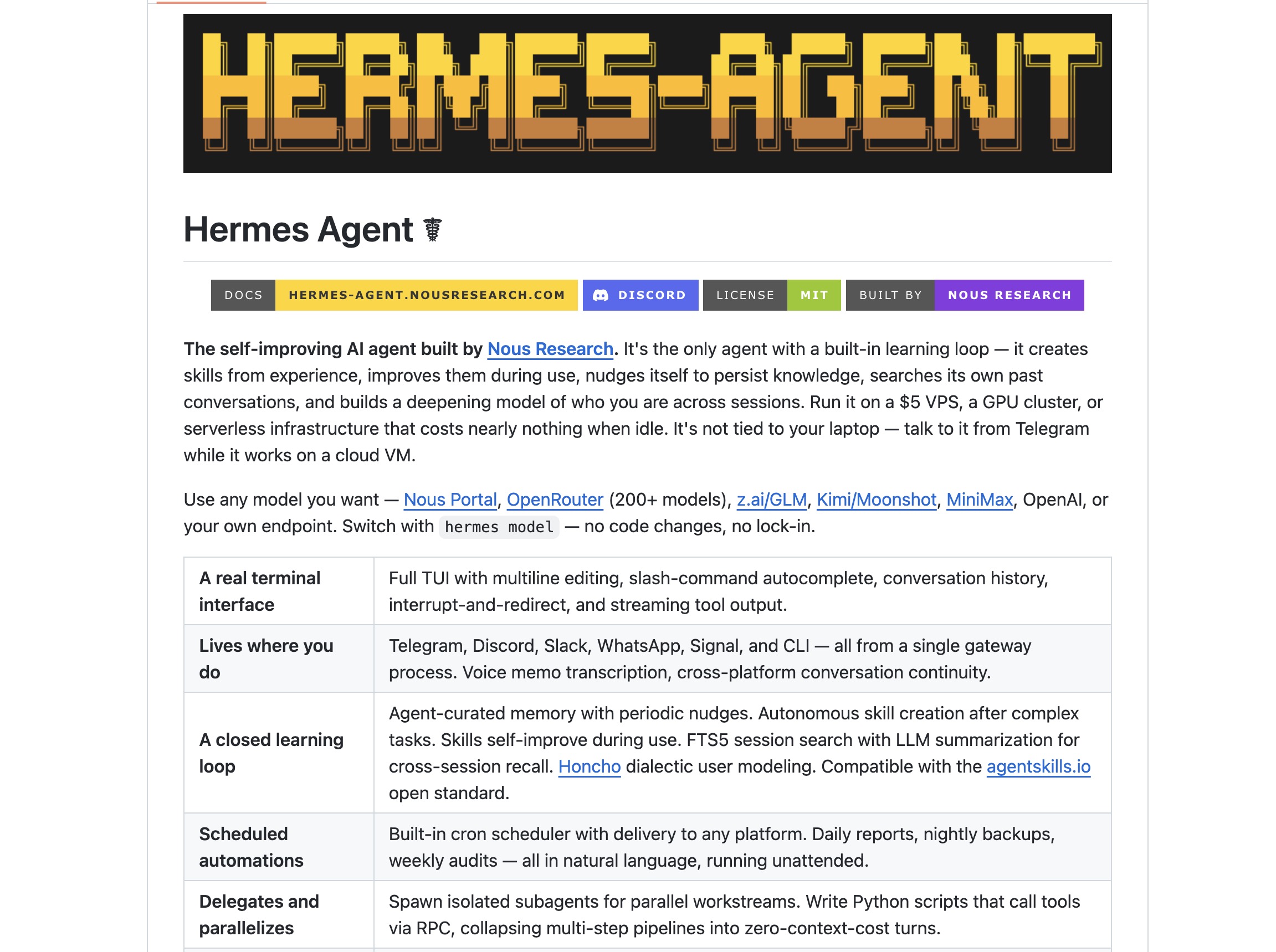
Self-improving open-source agent with persistent memory, reusable skills, 60+ tools, model choice, voice, scheduling, delegation, and 20+ messaging platforms.
What Hermes Agent is
Hermes Agent is Nous Research's open-source, general-purpose agent for people who want more than a disposable chat. Its learning loop can turn successful work into reusable skills, improve those skills over time, keep curated memory across sessions, and search past conversations. Hermes combines that continuity with a broad tool system for files, terminals, browsers, web research, code execution, scheduled jobs, delegation, media, messaging, and MCP servers.
You can use Hermes in its terminal interface, desktop app, web dashboard, an editor through ACP, or through a gateway that connects Telegram, Discord, Slack, WhatsApp, Signal, Microsoft Teams, Google Chat, email, and many other channels. It supports multiple model providers and local models, and independent profiles can keep each agent's configuration, credentials, memory, sessions, skills, schedules, and gateway state separate.
That flexibility also means Hermes is infrastructure you operate. You still need to choose model access, protect credentials, review skills and tool permissions, keep the runtime updated, and provide a machine or cloud environment that stays available when work should continue.
Why run Hermes on AI Agent Store Agent Teams?
Agent Teams hosting adds a managed operating layer around the native Hermes runtime. Hermes keeps its own reasoning loop, tools, skills, memory, schedules, model access, and ability to delegate; the hosting layer supplies an isolated cloud server, persistent workspace and browser state, health monitoring, encrypted checkpoints, recovery controls, and runtime updates with rollback. The practical benefit is that long research, coding, monitoring, and scheduled work can continue while your laptop is closed, without turning Hermes into a limited chat wrapper.
Manage several agents without losing the thread
The Chat Wall command center places as many as eight live Hermes or OpenClaw conversations in one view. Each panel keeps its own history, loading state, attachments, and native execution. This is useful when separate agents own research, engineering, content, operations, or customer work: you can compare progress and redirect the right specialist without opening eight terminals or messaging accounts.
The voice-first manager is designed for the same multi-agent problem. You can dictate a quick instruction, discuss and refine a request before sending it, or talk to a realtime manager that reads recent Chat Wall context and consults up to eight native agents in parallel. Voice is especially valuable when the bottleneck is supervising many agents rather than typing to one: ask for a cross-team status, interrupt, narrow the question, and receive one synthesized answer while each Hermes agent retains its specialist context.
Give browser agents the right network identity
Per-agent network routing lets a team use direct datacenter access, a static residential IP in an available country, or rotating residential routes. A static IP gives an agent a steadier network identity for approved social-media, marketplace, and account workflows where repeated country or IP changes can trigger extra verification. Rotating routes are better suited to permitted web research, price monitoring, or scraping workloads that need requests distributed across addresses; sticky or per-request rotation lets you match the route to the job. Protected routing can also stop traffic instead of silently falling back to the server's datacenter IP if a proxy becomes unavailable. These controls do not override a site's rules—users remain responsible for permissions, terms, rate limits, and applicable law.
Keep human control and model choice
Live desktop, browser, terminal, and file views let you inspect what Hermes is doing, complete sign-ins or other human-only steps, and take over when judgment is required. Model access options include platform credits, your own API keys, supported subscriptions, and configurable priorities or fallbacks, so a team can balance capability, quotas, and cost instead of binding every agent to one provider.
Create a hosted Hermes agent when you want Hermes's native autonomy with an always-available workspace and a control surface built for operating several agents at once.
Product overview
Capabilities, pricing and fit
Hermes Agent is an open-source, provider-flexible agent runtime from Nous Research built around a closed learning loop: persistent curated memory, searchable session history, agent-created reusable skills, and skill improvement during use. It combines those features with a broad tool registry, scheduled automation, subagent delegation, MCP connectivity, voice, multiple user interfaces, and a messaging gateway spanning more than 20 platforms. It can run locally or through container, SSH, and cloud backends, but users remain responsible for model access, credentials, permissions, security policy, and the reliability of the environment they operate.
Information as of September 20, 2026
What it can do
- Learning loop with memory and skills
Hermes maintains curated cross-session memory, can search past conversations, and can create or refine on-demand skills that preserve successful procedures without loading every skill into every prompt.[4], [7], [8]
- Broad native tool and extension system
Built-in toolsets cover web research, browser automation, terminals, files, code execution, media, messaging, scheduling, delegation, and other tasks; MCP servers, plugins, custom tools, and skills extend the runtime further.[5], [9]
- Multi-channel and voice operation
One gateway can expose an agent through CLI and numerous messaging platforms, while voice mode supports realtime speech and voice workflows across supported local and messaging surfaces.[4], [10]
- Scheduling and parallel delegation
Hermes includes cron-based unattended jobs with delivery and can delegate work to isolated subagents or execute tool pipelines programmatically for parallel and multi-step work.[1], [9]
- Flexible models and execution backends
Users can select among Nous Portal, commercial API providers, OpenAI-compatible endpoints, and local models, while terminal work can run locally, in containers, over SSH, or through supported cloud and sandbox backends.[1], [4], [6]
Where it fits best
- Power users and teams that want a long-lived, self-hosted assistant whose memory and reusable procedures can improve across research, coding, operations, and messaging workflows.[4], [7], [8]
- Operators running multiple specialist agents who need isolated profiles for configuration, credentials, memory, sessions, skills, schedules, and gateway state.[11]
Pricing and availability
Hermes Agent is open-source under the MIT License and has no framework license fee. The user pays for the machine or cloud environment and any selected model, search, browser, speech, image, messaging, memory, or other provider services. Nous Portal is an optional subscription route; bringing separate provider keys remains supported.[1], [2], [6]
Platforms: Linux, macOS, Windows, WSL2, Android via Termux, CLI and TUI, Desktop app, Web dashboard, ACP-compatible editors, 20+ messaging platforms[1], [4], [11]
Access: Local host, Docker, SSH host, Singularity, Modal, Daytona, Vercel Sandbox, Cloud VM[1], [4], [11]
Important considerations
- Hermes is software you operate rather than a turnkey managed service; the operator supplies and secures model credentials, integrations, compute, updates, and an always-on environment when continuous availability is required.[1], [6]
- Terminal, browser, file, messaging, and third-party skill access can be consequential. The project recommends command approval, sender authorization, scoped tools, container isolation, and careful handling of secrets and untrusted content.[9], [12]
- Voice, web search, image generation, TTS, browser services, and some memory or model options depend on configured local components, provider accounts, API keys, or an eligible Nous Portal subscription.[1], [9], [10]
Sources (12)
- Hermes Agent GitHub RepositoryGitHub · checked 2026-09-20
- Hermes Agent MIT LicenseGitHub · checked 2026-09-20
- Hermes Agent ReleasesChangelog · checked 2026-09-20
- Hermes Agent DocumentationDocumentation · checked 2026-09-20
- Hermes Agent QuickstartDocumentation · checked 2026-09-20
- Hermes Agent ConfigurationDocumentation · checked 2026-09-20
- Hermes Agent Persistent MemoryDocumentation · checked 2026-09-20
- Hermes Agent Skills SystemDocumentation · checked 2026-09-20
- Hermes Agent Tools and ToolsetsDocumentation · checked 2026-09-20
- Hermes Agent Voice ModeDocumentation · checked 2026-09-20
- Hermes Agent Profiles and Multiple AgentsDocumentation · checked 2026-09-20
- Hermes Agent SecurityDocumentation · checked 2026-09-20
Autonomy level
74/100
Our subjective rating of how independently the product carries out its documented tasks, considering the human setup, input, approval and review it needs. This is not a measured success rate.
Comparisons
Custom Comparisons
Some of the use cases of Hermes Agent:
- Building an assistant that retains curated memory and turns successful workflows into reusable, self-improving skills.
- Running research, coding, browser, terminal, file, messaging, and scheduled automation from one extensible agent runtime.
- Operating separate specialist agents with isolated profiles, credentials, memories, sessions, skills, and schedules.
- Using a native Hermes runtime on managed cloud infrastructure with Chat Wall, voice management, live takeover, recovery, and optional per-agent network routing.
Loading Community Opinions...
Pricing model:
Code access:
Popularity level: 72%
Tags:
Hermes Agent Video:
Turn this profile into a trust signal
Show prospects that Hermes Agent has a public place where they can check product details, pricing, ratings, and reviews.
Build confidence
Give buyers a third-party profile to explore.
Reduce hesitation
Put validation beside your strongest CTA.
Earn discovery
Every badge links prospects to your listing.
Choose your style
Preview it, then copy the complete embed code.
Shows buyers where to validate your product, pricing, and reputation.
Plain HTML. No signup, script, or maintenance required.
Describe the job. Get an AI worker you can actually message.
We create the setup, keep it running after your laptop closes, and save its memory. Test in the browser, then add Telegram, WhatsApp, or Slack.
Plans start at $199/month. Cancel anytime.
Hosted agent
OpenClaw or Hermes