
7 Best Ways to Make AI Writing Sound More Human in 2026
March 31, 2026 · 5 min read
AI writing tools are being used in our daily work. Bloggers use them to generate blog entries. Marketers use them to accelerate the launching of campaigns. Founders use them to put landing pages, emails, product updates faster.
While that speed is certainly helpful, it comes at a new expense. Much AI written material still reads ho-hum, boring, and overly familiar. It may be grammatically correct, but it‘s often cold, lacks flow, and has no character. Readers can tell.
If you seek higher engagement in 2026, your aim should not be to increase speed of publishing. Rather, your aim should be to make your writing sound natural, unambiguous, and persuasive. Below are seven actionable steps you can follow.
1. Start with a clear point of view
One reason AI writing feels robotic is that it tries to sound neutral all the time. Human writing usually has a point of view. It reflects a preference, a priority, or a real opinion.
Before you edit any draft, decide what the piece is trying to say. Ask yourself:
- What is the main takeaway?
- What should the reader believe after reading this?
- What matters most here: speed, trust, profit, ease of use, or accuracy?
Once you know the answer, shape the article around it. A clear point of view makes the writing feel more confident and less machine-made.
2. Replace generic phrasing with specific language
The AI uses many clichés and phrases that sound slick, but are ultimately meaningless to the reader because they have read it before. Cliches such as ‘in this day and age’ or ‘it should be noted’ make the sentence weaker.
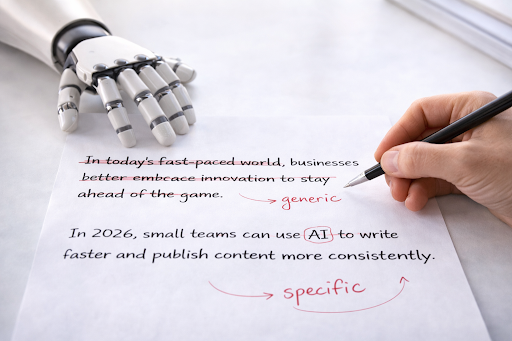
To make writing sound more human, replace vague wording with concrete language. Compare these examples:
Generic: Businesses can leverage AI to improve efficiency.
Better: Small teams can use AI to cut writing time and publish more consistently.
The second version is easier to make sound natural because it is more specific and easy to understand. It stated the benefits and the methods.
As a rule of thumb, if a sentence could span almost any article on the internet, it most definitely needs rewriting.
3. Vary sentence length and rhythm
Human writing has movement. Some sentences are short. Some are longer and more detailed. That variation creates a natural rhythm.
AI drafts often fall into patterns. Every sentence can feel the same length. Every paragraph may follow the same structure. That repetitive flow makes the content easier to identify as machine generated.
To fix this, mix things up:
- Use a short sentence after a long one.
- Break up dense sections.
- Ask an occasional question.
- Use transitions that sound conversational.
For example:
Flat version: AI tools help users create content faster. They also improve productivity. They are useful for many industries.
Human version: AI tools can speed up content creation. That part is obvious. The real advantage is that they help small teams do more without hiring as quickly.
The second version feels more alive because the rhythm is less predictable.
4. Add real-world context
AI can summarize common ideas well, but it often struggles to sound grounded in lived experience. Human writing earns trust by showing context.
That does not mean every article needs a personal story. It does mean the content should feel connected to real use cases, real audiences, and real outcomes.
Try adding context such as:
- what happens in a real workflow
- what small teams usually struggle with
- why a marketer, student, or founder would care
- what changes after applying the advice
When readers can picture the situation, the writing feels more useful and more human.
5. Edit for tone, not just grammar
A draft can be grammatically perfect and still feel wrong. That is why tone matters so much.
Many AI outputs sound too formal, too safe, or too eager to please. Good editing focuses on how the writing feels when read by a real person.
Look for places where the draft sounds:
- too stiff
- too repetitive
- too broad
- too polished in an unnatural way
This is also where the right rewriting workflow matters. Many content teams now use tools designed to turn ai to human text so drafts sound smoother, clearer, and more natural before publication.
That kind of final pass can improve readability without changing the core message.
6. Remove filler and keep what sounds true
AI tends to over-explain simple ideas. It adds filler to make the text sound complete, but that often reduces clarity.
Human writing respects the reader's time. It gets to the point. It keeps what matters and cuts what does not.
During editing, remove:
- repeated claims
- obvious transitions
- broad statements with no support
- extra adjectives that do not change meaning
For example:
Before: It is worth mentioning that one of the key benefits of using AI tools for writing is the fact that they can help users save a significant amount of time.
After: AI writing tools save time.
The shorter version is stronger because it says the same thing with less friction.
7. Read the draft out loud before publishing
This is still one of the best editing tricks available.
When you read it to yourself the awkwardness of the wording is not evident. Repetition is glaringly obvious. Sentences that appeared okay on the screen now sound clumsy or unnatural.
A sentence is difficult to pronounce often results in reading too. If a paragraph is too refined sounding to be spoken naturally by a person, then it is itself probably to be suitable.
A quick read-aloud pass helps you catch issues that grammar tools miss, such as:
- unnatural transitions
- robotic repetition
- weak sentence endings
- overly formal wording
This final step can make a major difference in how human the content feels.
Why this matters more in 2026
AI writing is no longer a novelty. Readers are more familiar with it now, and expectations are rising. Publishing fast is not enough. Content has to feel credible, useful, and natural.
That is especially true for:
- blog posts
- product pages
- outreach emails
- thought leadership content
- SEO articles meant to build trust
The brands that win in 2026 will not be the ones that produce the most words. They will be the ones that publish content people actually want to read.
Final thoughts
The assistance that AI can offer for writing is incredibly beneficial, yet strong content requires an intelligent human element. A straight forward workflow for success most commonly looks something like: draft quickly, edit more efficiently and then fine tune the output in terms of flow, tone and clarity.
If your material is too generic then one small change is rarely the answer. It is normally a series of small refinements to wording, flow, context, filler, personality etc.
That is what makes writing sound human.